Showing posts with label exploitation. Show all posts

Sunday, August 31, 2014

Pit Stop


Raw Guts For Glory!  Flesh Against Steel!


Jack Hill's 1969 auto-racing exploitation movie Pit Stop (filmed in 1967, produced by Roger Corman) is full of real race car action and plenty of fender crunching crashes and even features a couple memorable performances from its cast (one of who would be a future Oscar winner), not to mention the cool blues-rock soundtrack, groovy laid-back 60s vibe, and, hey!, lots of squealing tires on dirt. . . basically what I'm getting at is that this is another winner from exploitation writer/director extraordinaire Jack Hill.

Fun fact:  the original title for this film was The Winner.


Pit Stop follows tough-guy, drag racing loner Rick Bowman (Richard Davalos) who gets bailed out of jail by an unscrupulous promoter and car sponsor named Grant Willard (Brian Donlevy) and pulled into the world of figure-8 racing, which is exactly what the name implies: a looped-track race with an intersection.  It's crazy, but apparently exists in the real world.


Rick goes up against the hotshot local, wild driver Hawk Sidney (frequent Hill collaborator Sid Haig) and they develop a rivalry on the racetrack and off, some of it involving Jolene (Beverly Washburn), Hawk's dark-haired, wide-eyed groupie girlfriend (but as she says to Rick, she's "nobody's girl.")

Eventually Rick proves to be the better driver and Grant gets him into bigger races, real races, as a backup for Grant's ace driver, Ed McLeod (George Washburn), but Rick gets himself into further romantic trouble with Ellen McLeod (Ellen Burstyn, credited under her surname McRae), Ed's wife.
On paper, all of that seems pretty routine stuff for this kind of movie.  In practice, you got a whole different machine.
Here, let me give you 10 Reasons you should roll on over to the PIT STOP.


1.  Jack Hill, exploitation luminary.

In an interview once, Quentin Tarantino called Jack Hill the "Howard Hawks of exploitation movies," and the label has stuck over the years and that is because it's true and accurate.  Just like Hawks, Hill was adept at working in many different genres, all of them confidently.

While Hawks made A-list-type films in the war, drama, comedy, and western genres, Hill of course would make B-pictures (but stellar B-pictures) in genres as varied as horror (Spider Baby [1967]), blaxploitation (Coffy [1973], Foxy Brown [1974]), fantasy (Sorceress [1982]), women-in-prison movies (The Big Doll House [1971], The Big Bird Cage [1972]), girl gang action-dramas (Switchblade Sisters [1975]), and cheerleader flicks (The Swinging Cheerleaders [1974]).

Whatever material he worked with, Hill was able to elevate it.  He often wrote his own movies (as he did with Pit Stop), imbuing them with realistic and snappy dialogue and giving the film a specific rhythm (also with the editing, which Hill happened to do on this movie as well) that keeps things lively with a forward momentum.  It kept his movies from becoming run-of-the-mill drive-in fare and is part of the reason why his films are still enjoyable today and continue to be influential.


2.  The cinéma vérité style shooting, the realism, clever editing, & montage.
The first half of the movie features plenty of figure-8 racing and car crashes, all of which is exciting to watch.  The races were filmed at a real racetrack during actual races, documentary style with five cameras, led by director of photography Austin McKinney.  This guerrilla-style of shooting adds to the authenticness that runs throughout the film, a realism that is accentuated by the use of handheld cameras during the action scenes.

The real race footage is cleverly and seamlessly spliced into the scenes of the actors, most of which was filmed on sets and in non-race locations.  The editing is so superb that it is hardly noticeable and not nearly as jarring as similar tactics usually are on low budget pictures like this one.
The junkyard location, where Rick fixes up his cars and whatnot, usually in groovy montages, is also very cool and is definitely another highlight.  Hill and his crew really maximize the location for production value, with piles and piles of junked out classic cars, ruined from recklessness, that not only look cool onscreen but also perfectly echo the possibilities of living in the fast lane of race car driving.

3 & 4.  Sid Haig and Beverly Washburn.

Sure, Rick is the star of the movie and the main character (and actor Richard Davalos did play James Dean's brother in East of Eden [1955]...), but these two steal the show!  Haig, playing Hawk, is a wild man, with crazed eyes and facial expressions and an almost manic way about him.  He's a lively fella.

In some of the later scenes though, you get the idea that his bravado might be a coverup for some feelings of insecurity.  Haig plays the role large and is great fun to watch.  In a fun bit of trivia, Haig didn't know how to drive a car when he took the role of the fearless-driving Hawk.

His lady friend, Jolene, as played by Washburn, is equally fun to watch in a completely different way.  She's a gum chewing, dark-haired dish who does most of her acting with her expressive eyes.  She's kind of a weirdo in early scenes where she's hanging on Hawk, but later on there's real empathy for the character and the situation that she finds herself in.
One of the best scenes is when Hawk, sore over losing a race AND Jolene to Rick, heads out and gleefully smashes Rick's car up with an axe. . . while Jolene is cowering inside!  It's an intense scene, made more so by the frantic in-your-face handheld camerawork.

At this point in 1967, when this movie was filmed, Sid Haig and Beverly Washburn were part of Jack Hill's acting repertory.  Haig would work on most of the films Hill made; he and Washburn both starred in the excellent Spider Baby, which was filmed in 1964 but not released until 1967.

Fun Fact: Haig and Washburn both had roles on Star Trek: TOS, in Season 1's "The Return of the Archons" and Season 2's "The Deadly Years," respectively.
And of course, there's Jolene's "Why Not?" t-shirt...

5.  future Oscar winner, Ellen Burstyn.
This is one of Burstyn's first film roles and she makes the most of what is basically a wire-thin part as the neglected wife who is nevertheless devoted to her husband's work (she helps with the welding and engine work).  She's very restrained in her performance, and with that she brings a certain dignity to the character, a dignity that informs her later misguided attraction to Rick.

It's a wonderfully understated performance, she's fantastic, making an impression with her limited screen time.
Ellen Burstyn would, just a couple years after Pit Stop, star in Peter Bogdanavich's The Last Picture Show (1971) and receive her first of six Oscar nominations.  She would win a few years later for Scorsese's Alice Doesn't Live Here Anymore (1974) and she would also star in The King of Marvin Gardens (1972), Requiem for a Dream (2000), and, most famously, The Exorcist (1973).

I also have to mention she was a multi-episode guest star on season 4 of Louie, which was excellent.

6.  The cool blues-rock soundtrack.

The instrumental soundtrack is provided by a band called The Daily Flash, a psychedelic surf blues rock group.  Actually, it is just credited to them, as that band broke up before the movie came out and the soundtrack was recorded by some former members of The Daily Flash, as a group called Two Guitars, Bass, Drums, & Darryl.  Either way, the tunes are groovy and they really play well over the montage scenes.

Here's one of the tracks over a series of production stills.  Dig it:


7.  The dune buggy scene.


Dune buggies are cool.  These scenes were filmed at the Imperial Sand Dunes in Southern California, where dune buggy vehicles like the ones featured in Pit Stop are no longer legal to drive due to safety and environmental concerns.  Smaller and safer ROVs are allowed, but nothing like these hotrods here.  This short section of the movie is like a small peak into a bit of regional history.  Plus, you know, dune buggies..

8.  The car crashes - lots of em!
Crash, bang, smash.  If you like cars crashing into one another, this has got you covered.  The figure-8 racing is crazy and a lot of real crashes are captured in the movie.  Nobody was seriously injured while filming so you can enjoy the carnage guilt-free, which is good, because the mayhem is quite entertaining.

9.  The downbeat, somewhat existential, bummer ending.

I did not see that coming.  Sheesh.
Pit Stop ends with a downer of an ending, flipping the definition of a hero with Rick revealing his true character (and Grant, too), further defining his position as an outsider-loner whose selfishness is clearly self-evident (Grant just cements himself as the oily promoter).

I won't spoil the specifics of the ending of the movie, just know that it is decidedly downbeat and quite fitting for the era it comes from.  It brought to mind two wildly disparate things; the endings to both George A. Romero's Night of the Living Dead (1968) and Monte Hellman's Two-Lane Blacktop (1971).  Make of that what you will.

10.  The cool Crash-o-Rama movie trailer!

And here is the trailer again, but with Jack Hill commentary, courtesy of Trailers From Hell:


Final Thought:  Pit Stop is a great little auto-racing, 60s rock n' roll, delinquent, exploitation, action-drama, rising above its low budget and generic genre premise.  If you see it on your travels, be sure to stop and check it out.
"Is there anywhere in the world there isn't old beer cans?"
Yeah, maybe there would be if you stopped throwing your empties everywhere, ya dink!

Wednesday, May 22, 2013

The Town that Dreaded Sundown

The Town that Dreaded Sundown (1976) is a movie that I had never seen until now, even though growing up I used to see the VHS box cover on the shelves of the local video stores all the time and it always stood out to me.  That image of the bag-headed killer hovering above a sunset town was very intriguing and a bit spooky, as was the claim on the box that it was "a true story."

Usually when movies make that claim they are either half right (Texas Chainsaw Massacre [1974], which found inspiration in the real life killer Ed Gein) or just completely made up (as is with Fargo [1996]), but in the case of The Town that Dreaded Sundown, it truly was based on an actual series of murders that took place in 1946, with only the names of those involved and some of the details changed.  The movie is a decent piece of drive-in fare, albeit one with more than its share of problems, namely some wild tonal shifts into comedy and the piss-poor lighting and night photography.  The Town that Dreaded Sundown is far from a great movie, but it has a good idea and a memorable and iconic screen villain in "The Phantom Killer."
The Town that Dreaded Sundown has a basic story and premise, one that is not unlike the slasher films that would become popular half a decade after its release.  A mysterious and masked killer is randomly attacking the people of the Texarkana community, usually couples out in remote areas.  The local law enforcement, led by Deputy Ramsey (Andrew Prine), struggles to crack the case, and as panic grows, Texas Ranger Captain Morales (Ben Johnson) joins the hunt.  Part of the movie plays like a police procedural, as the authorities field phone calls from concerned citizens and deal with local nutcases coming in and making wild claims.

The movie is also presented in a docudrama style, with a narrator that introduces the film and occasionally pops back in to fill the audience in on backstory and other facts in the case.  In addition to that, the calendar dates of the murders flash on screen and, along with the narrator, this gives the film (which is otherwise shot like an ordinary horror film) a feeling or look of a television true-life mystery program, like an Unsolved Mysteries but with better reenactments.  (note:  I thought that Unsolved Mysteries analogy was an original thought, but turns out that comparison is mentioned on the film's wikipedia page.  Sigh. . .so much for original thoughts...)
In 1946, during a ten week span between February and May, eight people were attacked, five of which were killed, in the small town of Texarkana.  The attacks took place late at night and on weekends and were usually three weeks apart.  They took place mostly in the remote surrounding areas on both sides of the Texas and Arkansas border.  The Phantom Killer, as he became known, shot all his victims to death using a pistol.  The crimes became known as the Texarkana Moonlight Murders and despite the efforts of local and state law enforcement, the case has never been solved.

The movie differs from those true-life events in changing some of the dates of the murders and some of the details, making the stalking scenes and the sadisticness of the crimes that much more frighteningly cinematic.  The real Phantom Killer did indeed wear a white bag on his head with eye holes cut out, which is why the survivors of his first attack could not identify him.  It is quite the creepy look, one that Jason Vorhees would borrow in Friday the 13th Part 2 (1981).

In the actual murders, the killer used a gun exclusively, with minimal bludgeoning and perversion, although psychiatrists did theorize that he was a sex deviant.  The movie version of The Phantom is said to have "bitten and clawed" one victim like an animal, although that is done off-screen.  Also, there is no evidence that the real Phantom Killer ever used a trombone to kill anyone.
This should be explained as it is easily the weirdest thing in the movie, which also makes it one of the most memorable things.  Normally I would consider this a SPOILER but I can't not bring it up and mention it, it's just such an out-of-left-field moment.  On the night of the High School Prom, a young couple, Roy and Peggy, head out to their favorite make-out spot, despite their better judgement and the fact that the town is on high alert at this time.  After making out, the two of them fall asleep in the car, only waking up much later at night.  When Roy tries to leave, the Phantom suddenly leaps onto their car and pulls Roy from the vehicle.  After whacking Roy in a head with his pistol, the Phantom chases down Peggy in an extended chase scene and after catching her, he ties her to a tree.  When Roy tries to escape, the Phantom shoots him dead.  The killer then goes to the car, gets Peggy's trombone case, and proceeds to tie a knife to the end of the trombone slide.  He then "plays" the instrument, stabbing Peggy to death.  It's quite the fucked up scene, not only because of the absurd use of a brass instrument, but also for the brutal length and duration of the chase and stalking.

In general, the stalk and kill scenes are pretty good.  They're lengthy, with a good amount of time devoted to tension build-up.  Even when not onscreen, The Phantom's presence haunts the film.  When he does pop up out of nowhere and attacks, it is genuinely freaky and disturbing, maybe none more-so than when The Phantom breaks into Helen Reed's (Dawn Wells) house and assaults her.
The Town that Dreaded Sundown is a cheap drive-in exploitation movie and it does on occasion fully display its cheapness.  The night photography, especially during the first two attacks, is extremely dark and murky.  After discovering a pair of victims, Deputy Ramsey chases The Phantom through the woods during a rainstorm and it is near impossible to see anything that is going on.  The lighting is better for some of the later scenes, but is still wildly inconsistent.

Also inconsistent is the tone of the movie.  In multiple scenes, the film dips into a broad territory of comedy, most of it delivered by hapless doofus Police Patrolman Benson, who is tellingly nicknamed "Spark Plug."  At one point, Spark Plug dresses as a woman (as part of an attempted trap to lure The Phantom) and at another point he drives a car into a lake.  It really is eye-rollingly bad, and not made any better by the fact that Patrolman Benson is played by director Charles B. Pierce. The swing from brutality to broad comedy leads me to compare the film to The Last House on the Left (1971), although the hayseed comedy of The Town that Dreaded Sundown is much worse and it never reaches the levels of vile sadisticness of Wes Craven's shocker.
Since this is based on a true story, the pseudo-documentary style adds to the unsettling nature of the film.  Director Charles B. Pierce, who definitely brings a regional flair to his films, had experimented with this format before with his first feature film The Legend of Boggy Creek (1972), in which local townsfolk recount their encounters with the titular Bigfoot-like creature, complete with reenactments of said encounters.  Pierce would go on to direct the western Grayeagle (1977), the viking film The Norseman (1978), the home invasion thriller The Evictors (1979), and a sequel to his first film, Boggy Creek II: And the Legend Continues (1985), which is really really corny and was featured on the tenth season of Mystery Science Theater 3000.
Strangely, Charles B. Pierce was just a director/writer/producer/actor on the side, as his main occupation in Hollywood was Set Decorator.  While funding his own little projects, he worked on such varied films as Pretty Maids All in a Row (1971), Coffy (1973), Scream Blacula Scream (1973), Dillinger (1973), Black Belt Jones (1974), The Outlaw Josey Wales (1976), and Carny (1980).

Screenwriter Earl E. Smith wrote many of Pierce's early movies.  Pierce and Smith both have story credit on Clint Eastwood's Sudden Impact (1983), the fourth Dirty Harry movie.
There is a Sheriff character in the movie, but he seems to take a backseat to Andrew Prine's Deputy Ramsey.  Prine brings a bit of that small-town Texas swagger to Ramsey, and he has a couple good scenes, particularly the one where he chases the killer through the woods, as well as the ending, where he and Captain Morales give The Phantom one final chase.  Andrew Prine is one of those B-movie actors that I'm fond of; he also starred in Simon, King of the Witches (1971), The Centerfold Girls (1974), Grizzly (1976), and Eliminators (1986).
I'd have to say this is far from his best work, but Ben Johnson does what he can with Texas Ranger Captain Morales.  Johnson had a long career as a stunt man in the 40s, (doubling for John Wayne and James Stewart), starred in westerns in the 50s, and in TV shows in the 60s, which is where he met Sam Peckinpah, whom he would work with on The Wild Bunch (1969), Junior Bonner (1972), and The Getaway (1972).  Ben Johnson would also work with Peter Bogdanovich on The Last Picture Show (1971, for which he won an Oscar), John Milius on Dillinger (1973), Steven Spielberg on The Sugarland Express (1974), and a bunch of Canadians on Terror Train (1980).  He would work with Charles B. Pierce again on Grayeagle (1977).
Dawn Wells, who played home invasion survivor Helen Reed, is famous for playing Mary Ann on TV's Gilligan's Island.  Strangely, she also starred in Return to Boggy Creek (1977), which is more of a kids fantasy movie than a sequel to Charles B. Pierce's film (he was not involved whatsoever).
Composer Jaime Mendoza-Nava worked with Charles B. Pierce often and also scored that weird-ass movie Mausoleum (1983).

Stuntman Bud Davis, who plays The Phantom (pretty well, in my opinion), would go on to a successful career as a stunt coordinator on big Hollywood films like Forest Gump (1994) and Inglorious Basterds (2009).
The Town that Dreaded Sundown has a pretty good idea and premise.  The pseudo-documentary construction makes the film unconventional and interesting and the sparseness of the story works in the film's favor, as does the ominous and creepy baghead that The Phantom wears.  It's only in some of the narrative choices (i.e.: terrible comedy) and with some of the shoddy production values that the film falters.  The film also gets points for having a non-ending (and handling it well), with no answers and no real resolution, as the killer is never caught.

In reality, the killer was never brought to justice and rumors abound as to what happened to him.  Some claim he was arrested for an unrelated charge, while some believe he would pick up his murder spree years later in the San Francisco area as The Zodiac Killer.  What truly happened to The Phantom Killer is anyone's guess, as at this point it seems as if the truth about this serial killer will remain a mystery.

The Town that Dreaded Sundown (at least the VHS transfer I watched) is very rough looking, with washed out colors and dark, murky lighting.  The night scenes are frustratingly dark; it looks like they were shot in actual darkness; like night for night.  Hopefully, Scream Factory's new HD BluRay/DVD combo release (decked out with bonus features, including a bonus movie: Pierce's The Evictors [!!]) goes a long way in correcting these problems (and from what I've read and seen, it does indeed).

 
The above screencap is from the version I watched.  The below picture I found is from the same scene and is apparently from the new BluRay.  Andrew Prine's face says it all.

Friday, May 3, 2013

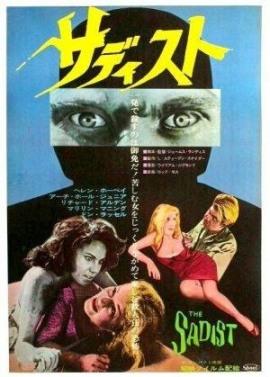
The Sadist

I spend a lot of time watching movies, a good portion of which are exploitation and B-movies that I find myself compelled to mine through in an effort to find cinematic gold.  The movies can have, to say the least, extremely varying quality, and the task of culling through the prospective titles can seem laborious and defeatist, but then a movie like The Sadist (1963) comes along and it makes the whole process worthwhile.

The Sadist has a simple and straightforward narrative, but its approach to storytelling is advanced for a film made in the early 60s, as the action takes place in real-time, ratcheting up the tension.  Also, the movie is surprisingly brutal and unapologetic, with a seedy and uneasy atmosphere.  The Sadist is a master class to young filmmakers on how to make a great movie with only a single location, a handful of actors, and very little money.  All you need is a solid script and a future Oscar winning director of photography.
The Sadist opens with a trio of high school teachers driving through the California countryside on their way to a Dodger baseball game.  Unfortunately they have a bit of car trouble and have to pull over at an old junkyard/service station and even more unfortunately, nobody seems to be around.  The three of them wait and just sort of mill about before deciding to fix the car themselves.  Suddenly, they are confronted by the gun wielding Charlie Tibbs (Arch Hall, Jr.) and his hanger-on girlfriend Judy (Marilyn Manning).  Seems our teachers have chosen the wrong rest-stop at which to pull over.
Charlie is an amoral maniac, loose on a two-state kill spree with his slightly deranged girlfriend in tow.  Holding the teachers hostage, he psychologically and physically tortures them while he forces Ed (Richard Alden) to fix the car with intentions of using it as a getaway vehicle.  Charlie waves his gun around menacingly while he sneers and makes threats, following through on a couple of them.  Charlie shoves Doris (Helen Hovey) down to the ground, rubs her face into the dirt, and manhandles her a bit.  Carl (Don Russell), the oldest of the three teachers, tries to reason with him, but his pleas only seem to push Charlie further, resulting in Carl getting pistol-whipped. Charlie then takes it another step by taking Carl's wallet and shredding his family photos AND their baseball tickets!  Harsh, man.

The harshness of the psychological torture is matched by the film's unflinching brutality.  Not even halfway into the movie, in a scene that doesn't use any cutaways or clever editing, Charlie (SPOILERSPOILER) kills one of the captives!  What makes it more chilling than shocking is that he does it for no reason other than his own amusement.  He does it strictly for kicks!  It is at this point where The Sadist turns the corner on being a second-rate B-movie and becomes a white-knuckle-thriller, grabbing you by the collar and bringing you to the edge of your seat.  
The Sadist was made on the most modest of terms.  With a budget of $33,000 and a cast of mostly inexperienced unknowns, the film was produced by Arch Hall, Sr. (who also provides the opening narration for the film) and his Fairway International Pictures, which was a poorly bankrolled independent company known mainly for producing schlocky drive-in fare.  One of Arch, Sr.'s chief goals as a film producer was to help launch his son's rock n' roll career and turn him into the next Ricky Nelson.  Arch, Jr., for the most part, just seemed to be along for the ride, helping his dad make some money and half-assing it in movies like Wild Guitar and Eegah (both 1962).  Arch, Jr. would eventually leave acting to pursue his true dream: being an airline pilot, a job he held for 35 years until he retired in 2003.

In The Sadist though, Arch, Jr. really goes for it, getting dangerously close to going over the top, but keeping it just on this side of MEGA-acting.  Instead of his guitar, he wields a gun and instead of crooning love songs he sneers and giggles while asserting his dominance over his captives.  It really is a bravura performance, as his unpredictability and unrelenting menace make him a captivating screen villain.
Arch Hall, Jr.'s facial features are another thing that adds to his performance as Charlie.  His doughy face has been described as looking like everything from a "demented baby" to "that bat from Ferngully."  His youthful appearance though adds to the threatening persona that he wields.  It's a shame his heart wasn't in acting and it's a double shame that he's probably better known for Eegah, the goofy caveman-in-modern-times movie starring Richard Kiel, which was featured in a fantastic Season 5 episode of Mystery Science Theater 3000.  In that one, Arch, Jr. pretty much just drives around his dune buggy and plays a few tunes on his guitar, nothing as truly memorable as his deranged take on Charlie Tibbs in The Sadist.
His girlfriend Judy gives The Sadist an extra level of creep.  She doesn't really speak in the movie, but she does whisper things to Charlie and seems to egg him on quite a bit.  She definitely seems to be compliant in what Charlie is doing, but it is never quite clear what Judy is thinking.  At times she acts like a little girl, excited about make-up and perfume she finds in Doris' handbag, and other times she gets all crazy eyed while brandishing a knife.  Marilyn Manning brings a subtleness to the role, giving Judy these little mannerisms that reveal her wildness and most (if not all) of her acting is conveyed through her eyes.  She girlishly flirts with Charlie, doing a little dance for him at one point, and they act like any other pair of goofy kids in love.  It's just that this goofy couple are unstable and without remorse.
Marilyn Manning also starred with Arch, Jr. (and Arch, Sr., for that matter) in Eegah, in which she was also cast as Jr.'s girlfriend.  In that movie, her performance is. . .not that good (to be fair, nothing about Eegah is that good), so it is interesting that they managed to get a solid performance out of her on The Sadist simply by not giving her any dialogue.

Also:  for anyone that has actually seen Eegah, watching Tom and Roxy from that movie run around terrorizing people in The Sadist makes the viewing experience that much more strangely awesome.
The other actors in The Sadist didn't really go on to do anything else.  Richard Alden, the only professional actor in the film, would toil for a couple decades in TV and bit-part obscurity.  He's pretty good as Ed, although he is a frustrating character whose cowardly optimism makes him a fairly ineffective hero in the story.  His masculinity seems to constantly wilt to Charlie's demented will.  Doris, on the other hand, has much more resolve and fight in her, especially as the film moves along.  Helen Hovey was Arch, Jr.'s cousin (making his terrorization of her a little extra creepy) and this was her first and only movie appearance.
In addition to being the sympathetic Carl, Don Russell was also the film's production manager, a role he also performed on Wild Guitar.  Interesting enough (and to continue the MST3k connections) Russell was second unit director as well as the henchman Ortega in the truly dreadful The Incredible Strange Creatures Who Stopped Living and Became Mixed-Up Zombies (1964), a film that was briefly second-billed with The Sadist at drive-ins.
The true star of The Sadist (with all due respect to Mr. Hall, Jr.) is not in front of the camera, but behind it rather.  This was the first credited American feature film to Hungarian-born cinematographer Vilmos Zsigmond, here credited as William.  Every inch of the frame is carefully composed, as the camera peeks through broken windows, peers over shoulders, and glides around the junkyard.  Most importantly, it leers at Arch Hall's sweaty goon-face, allowing little respite from his madness.  Zsigmond's work on The Sadist elevates the film to a much higher, professional looking level.  The movie was shot in 35mm over three weeks and Zsigmond would layer the set with cars and junk and create depth in the frame using a lot of deep focus and long lenses.  The cinematography in The Sadist is among the best you'll see in any B-movies from the 1960s.

Vilmos Zsigmond would work with director James Landis and Arch Hall on a couple more films, the strange "comedy" (but awesomely titled) The Nasty Rabbit (1964) and Deadwood '76 (1965) before continuing his B-movie career on some of schlockmeister Al Adamson's pictures and the like.  His first major "straight" movie was Peter Fonda's The Hired Hand (1971) which would lead him directly into working on Robert Altman's McCabe & Mrs. Miller (1971).  Zsigmond would team with Altman again on Images (1972) and the fantastic The Long Goodbye (1973), and he would also shoot 70s classics like Deliverance (1972), The Deer Hunter (1978) and Close Encounter of the Third Kind (1977), for which he won an Oscar.  Entering the 1980s, Zsigmond would shoot Brian de Palma's Blow Out (1981), which, after scanning his credits, might be his last significant film, although I have to admit some affinity for both Real Genius (1985) and The Ghost and the Darkness (1996), both of which star Val Kilmer, which is kind of weird (on my part, not Vilmos' part).
The kill crazed lovers in The Sadist are inspired by the real life kill spree perpetrated by Charles Starkweather and his 14-year old girlfriend Caril Ann Fugate (seen above) across the Midwest in the late 1950s.  Their wave of terror would introduce a new villain into American mythology:  the thrill killer.  Arch Hall, Jr. does a good job capturing the look and the unhinged characteristics of Starkweather.  Ten years after the release of The Sadist, Terrance Malick would direct his debut film, Badlands (1973), also inspired by the Starkweather events (although a much more lyrical and less thrilling version of the story) starring Martin Sheen and Sissy Spacek.  Other films like Natural Born Killers (1994) and The Frighteners (1996), as well as songs by Bruce Springsteen and J Church, would also find inspiration in the story of Charles Starkweather.  The Sadist, however, was there first.
The Sadist does have some problems with the occasional choppy editing and the final chase during the ending seems to drag on and on a bit, but the finale itself is very satisfying and the film still has a great economy to its storytelling and is a fantastic minimalist effort.  The Sadist has a matter-of-fact starkness about it.  Taking place in a remote, mostly barren landscape, the unbearably hot sun that beats down on the characters mirrors the unbearableness of their ordeal and how there seems to be little hope of escape.  Punctuating this sense of hopelessness, at one point Charlie flips on a car radio and the Dodger baseball game is on, the game that Doris, Ed, and Carl were supposed to be at.  It is another gut punch reminder of where the three of them should be and where they actually are.  Along with Charlie and Judy's manic craziness, this unrelenting amount of tension was not common among other drive-in quickies of the day.

Upon release, The Sadist did not do well at the box office.  Audiences expecting cheap drive-in thrills got something much more gritty and downbeat.  The film would quickly fall into obscurity, seeing a rerelease in the 70s (under the title Sweet Baby Charlie) that caused little to no fanfare.  The film would start to find an audience on the home video market and has slowly been gaining the recognition that it deserves since then.
Now 50 years after its release, The Sadist still hold up extremely well and proves to be an exploitation cheapie that rises far above its pedigree.  Its visceral and unapologetic tone are right in line with a lot of modern thrillers, and in some ways it's a much more entertaining movie than many of those films.  Its powerful minimalist nature, combined with its tick-of-the-clock real-time narrative make The Sadist one of the the most criminally underrated and underseen exploitation B-movies of the 1960s, or any era.
*This first trailer for The Sadist is a UK DVD release trailer from 2008.  It does a pretty good job of conveying the story without giving away any major spoilers.  Watch it!

*This next one is the original theatrical trailer and like a lot of movie trailers from the era, this is fairly heavy on the spoilers and whatnot, so watch at your own risk.  I'll also mention that the guy doing the introduction in the trailer is Arch Hall, Sr. (Nicholas Merriweather was his pseudonym) and he provides the narration as well.

Fun fact: as a budget saving measure, during production live ammunition was used in some scenes.  BANG!
Here's a cast/crew photo, not sure who director James Landis is, but I'm fairly certain that Vilmos Zsigmond is the guy smiling and sitting next to the camera with his hands on his knees.

Watch out for snakes!