Showing posts with label John Carl Buechler. Show all posts

Friday, November 13, 2015

Friday the 13th Part VII - The New Blood


Released in 1988, Friday the 13th Part VII - The New Blood has a premise that involves a girl with psychic powers going up against the recently returned Voorhees (new blood, indeed).  It is often summarized by fans as being "Carrie vs. Jason," but that summary isn't really accurate, as the "VS" part of the movie is relegated to the final 10 minutes or so.  The rest of it is standard Friday fare, with a group of young people just looking to have a good time but instead getting murdered in various ways.

Until this week I had only seen Part VII of the Friday the 13th saga once, back about 20 years ago when I was watching the series for the first time.  In general I am much more familiar with the front half of the Friday franchise than with the back half, so this was fun revisiting a movie I hadn't seen since I was a teenager.  Unfortunately, this turns out to be my least favorite of the first seven Friday films.


The movie opens with a recap of Jason's history and a summary of the events of Part VI.  Basically it all serves to remind the viewer why Jason is chained to a big rock in the middle of Crystal Lake.  Notable in this opening is two things; the voiceover narration is provided by Walt Gorney, better known as Crazy Ralph from Friday Parts 1 and 2, and the recap montage uses footage from the Friday Part VI teaser trailer, specifically the shot of the graveyard and the tombstone exploding.


After the refresher and the credits roll, we get a scene set in the past, where a young girl named Tina witnesses her parents having an argument that leads to physical abuse.  This probably isn't something new to the family, as little Tina, upset and afraid, runs toward the lake and paddles out in a boat, her father running after her.


While on the water, and with her father standing on the dock, Tina's psychic telekinetic powers manifest and cause the dock to collapse into the lake, taking her father with it.  Little Tina is very sad and traumatized.


Flash forward 10 years later, much of which she spent in psychiatric care, and Tina (Lar Park-Lincoln) is now returning to that lake house, along with her mother (Susan Blu) and her psychiatrist Dr. Crews (Terry Kiser) for further treatment.

Her recovery has come along nicely, but Tina foolishly goes down to the lake and accidentally raises Jason out of his watery prison (she does this psychically, trying to raise her father up for some reason).

Jason then goes on his mandatory murder spree (as is his wont) before Tina, in the finale, confronts him and does battle with Jason WITH HER MIND!
Note about the timeline:  The events with young Tina happened in 1989, with the rest of the movie taking place 10 years later (1999).  So at this point, Jason has been in the lake for a couple years, as the events from Friday Part VI took place in 1997.
Note about the note:  I know and realize that the filmmakers behind these films gave little to no thought towards the continuity between films, but I find it really interesting that most of the sequels take place in the future relative to the year each film was released.  For example, Friday Part VII was released in 1988 but, when following the timeline established, the events must take place in 1999.  Weird, right?

Anyway, Friday the 13th Part VII - The New Blood is not a great movie, but I do appreciate that it was trying something different with the franchise.  I think there should've been more focus on Tina and her abilities and I would've liked to see her do more battle with Jason.  The very end of the movie feels rushed and a bit like an anti-climax, which is unfortunate.

What really sinks this one is the multiple cuts and trimmed scenes that the MPAA ratings board demanded be removed from the film to secure an R rating.  These extra gore scenes are available in a really rough form on the DVD/Blu releases and a couple of them are really fantastic and would've really improved the film and made it more exciting and interesting.  As it is though, unfortunately, I have to say, even though it has the intrinsic "funness" associated with Friday the 13th movies, Friday the 13th Part VII - The New Blood is one of the weaker entries in the series.  However, I don't think I'll wait another 20 years before watching it again.
It's a birthday bash.
Notes:

Playing Jason for the first of what would be a record four times is stuntman/actor Kane Hodder.  This is perfect casting, seeing as how being underwater all those years really made Jason swell up to a Kane Hodder-like size.  It works!

Seriously though, Hodder puts in a solid performance as Jason, giving him a real hulking presence while remaining light on his feet (see: the part where he jumps through a window).  He also has this great scene where he's set on fire and at the time it was the longest onscreen burn ever done by an actor.  Very impressive.
Best kill in the movie is easily the sleeping bag kill.  In the version that was cut out, Jason gives her about six good wallops against that tree, which is great, but what we see in the final movie is just one good whack that kills her instantly.  It's less ridiculously brutal, but in its own way it still packs a punch.  It's one of the most iconic kills in the entire franchise.
As for the other kills in the movie, most of them are pretty standard stuff, which, once again, is a shame because some of the cut footage is really amazing, particularly this spectacular head crushing scene and the death of Dr. Crews, who gets a tree trimmer to the torso and his guts go everywhere.  These things are fine and all as they are in the finished movie, but they could've been so much more!
Also, there is a kill in the lake with a naked girl that is filmed partly beneath the water that is an obvious homage to the opening of Jaws.  I got nothing else to say about it; just something I noticed.
Jason's new look includes him wearing a chain, which is part punk rock, part hip-hop, and very chic.
During the finale when Tina is using her psychic powers against Jason she picks up a potted plant and throws it at him.  By itself this is uninteresting.  What does make it interesting/hilarious is that resting in the potted plant is the decapitated head of one of her friends.  Ha!


Tina's mom in this movie, Mrs. Shepard, played by Susan Blu, has some absolutely out of control 80s hair.  It's fantastic!  There are some really great mullets and things like that throughout the cast, but mom's hair is seriously the greatest thing.


Speaking of Mrs. Blu, her appearance here in Friday Part VII marks one of her rare onscreen roles, as she is mainly a voiceover actress, providing voices on TransformersJemDuckTales and a slew of other things over the years.

Director John Carl Buechler is a special effects expert, having provided work for many Charles Band productions, like TerrorVision (1986), Dolls (1987), and Prison (1987), which is where he met Kane Hodder.  Buechler got the job because of his work on Troll (1986), which is strange if you've actually seen Troll.

Buechler also did some effects work on Nightmare on Elm Street 4: The Dream Master, which came out the same year as his Friday Part VII, a few months later actually, and did more than twice as well at the box office.
This marks the first time that Harry Manfredini was not the sole composer on a Friday movie.  Fred Mollin would provide most of the score and would go on to be the composer for Friday Part VIII and the Friday the 13th television series as well.


Lar Park -Lincoln was in House II: The Second Story in 1987 and she also had a reoccurring role on Knots Landing starting around the same time.  I think she makes for a really interesting final girl and to her credit she does attempt to do something a little different with her portrayal of psychic abilities (she's not just ripping off Sissy Spacek in Carrie).

Kevin Spirtas (credited as Kevin Blair) is Nick, the secondary protagonist and love interest to Tina.  He's likable enough but doesn't really do much in the movie.  Spirtas was also in the wonderfully cheap and cheesy The Hills Have Eyes 2 (1984) along with Kane Hodder and would go on to star in a couple Subspecies movies and would have a long 10 year stint on Days of our Lives.


Terry Kiser, who plays the jerk Dr. Crews, would go on to play the titular character in Weekend at Bernie's (1989) and it's 1993 sequel, which is fairly awesome and there is nothing else to say about it.
Final Thought:  Not terrible and not great.  I can say this about it though:  How many Part VII's of movie franchises are there out there?  Not many.  And Friday the 13th Part VII is one of them.

This poster from Ghana is freaking CRAZY!!
Read the rest of my Friday reviews:
Friday the 13th
Friday Part II
Friday Part III
The Final Chapter
A New Beginning
Jason Lives

Happy Friday the 13th!


Sunday, March 31, 2013

Dolls

The third and final installment of Stuart Gordon appreciation week,
catch up on Re-Animator HERE
and From Beyond HERE,
if you missed them.

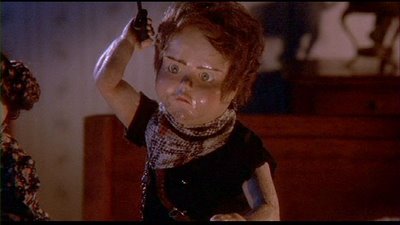
Up until now, I had never seen Dolls (1987) before and I'm not sure why.  I've seen it on the shelves at the video store for years, I'm aware of who made it, and what the premise was. . .but maybe that's the problem.  Personally, I'm not a big fan of the killer doll/puppet sub-genre of horror films.  I know they have their fans and supporters, etc., but for me creepy dolls work better when they are just part of a film, like the clown doll in Poltergeist (1982) or that mannequin in Deep Red (1975) or that creepy fucker in that one Spanish movie I saw that one time (Satan's Blood [1978]), rather than when they're the main villain or threat.  Movies like Child's Play (1988) or Puppetmaster (1989) have decent concepts, but they seem to stumble in execution.  The base concept of a killer doll is scary, but in practice I usually find myself wondering why anybody would run from a little thing like that and just not, you know, kick it away and smash it or whatever.  I mean, it's little, it can't have that much body strength.  I guess Dolls goes a little way in covering this by having an army of killer toys running around.  Harder to squish when there's dozens of them.  Of course, maybe I'm over-thinking the legitimacies of a concept involving dolls that happen to be living...

Let's talk about the movie instead.
Dolls has a classic horror movie opening, where a family is traveling the countryside and they get caught in a rain storm, the kind of storm in horror movies that forces people to pull over (in this case, the car gets stuck) and spend the night at a stranger's house.  Young Judy (Carrie Lorraine) is on a trip with her father David (Ian Patrick Williams) and evil stepmother Rosemary (Carolyn Purdy-Gordon), when they find themselves in this scenario and they seek refuge in a creepy old, gothic mansion, yet another convention of horror movies.  The occupants of the old mansion are an elderly couple, Gabriel and Hilary Hartwicke (Guy Rolfe and Hilary Mason), who greet their unexpected visitors kindly, especially Judy.  They are joined by yet another group of stranded travelers, who literally barge into the house, consisting of good-hearted doofus Ralph (Stephen Lee) and the two British punk rocker girls, Isabel (Bunty Bailey) and Enid (Cassie Stuart), that he picked up hitchhiking.

The house is populated by a bounty of (you guessed it) dolls, most of them those weird porcelain type dolls that you'd see at flea-markets or at your grandmother's.  Judy and Ralph take an interest in them, Judy because she's a little girl, Ralph because he seems to be "young at heart," as they say.  Everyone else seems to go out of their way to be unpleasant and obnoxious.  Judy's dad is a real jerk who is a bit of a gold digger and treats Judy as if she's a burden.  His new bride Rosemary is one of those snide, fashionable bitches, who bluntly states that they "could be in Monte Carlo now, if it wasn't for the twerp."  The punk rock girls aren't much better, revealing themselves to be thieves, first planning on robbing Ralph, then stealing some of the antiques (or "ann-tikis") from the mansion.  This leads to their undoing, as the dolls seem to be vindictive against anybody without a kind or innocent spirit (which is why Judy and Ralph are safe, more or less).
The dolls use weapons, like knives and hammers, and they also have sharp little razor teeth.  There's even a set of toy soldiers that have working rifles!  The special effects are a combination of puppetry and mechanical effects with the occasional bit of stop motion work.  When not seen, the dolls can be heard skittering and scurrying about on the floor making little chattering, squeaky noises, which I found annoying rather than creepy.

The effects are sometimes goofy looking, but the murders are entertaining and clever enough, with a couple cool transformation scenes.  Rosemary's death and the discovery of her body is a particularly gruesome scene, as is the Teddy attack scene, which is one of best in the movie, even though it doesn't really happen.

After the family's car gets stuck and they're walking to the creepy mansion, Rosemary pulls a bitch move on Judy and throws her teddy bear (Teddy) out into the woods, saying that it'll just "slow her down."  Judy has an overactive imagination, and she imagines Teddy emerging from the woods, the size of a real bear, and he sheds off his teddy bear skin, revealing a terrifying bear monster underneath.  Teddy then proceeds to maul dad and rip Rosemary's arm off.  When done, Judy just shakes her head and says, "oh, Teddy," and then Teddy just shrugs his shoulders.  It's kind of a funny idea, this kid having such violent daydreams, and I like the image of a teddy bear that turns into a giant monster better than I do killer dolls running around all over the place.  A character called "Grizzly Teddy" in the movie Demonic Toys (1992, also produced by Charles Band) seems to be directly inspired by Teddy.
The plot to Dolls is bare bones, the running time a brisk 77 minutes, and the ending a little anti-climatic and unsatisfying.  Ralph and Judy wake up from being knocked out and Gabriel tells them it was all just a dream.  He reads them a letter from Judy's dad saying that they've left and that she should go back and live with her mother back in the city.  Ralph asks about the hitchhikers and Gabriel quickly adds, "oh yeah, and we dropped off the hitchhikers," before throwing the note into the fire.  Ralph and Judy then drive off, Judy having ideas that Ralph will marry her mother.  It's an abrupt ending, almost childlike in its simplistically, like a fairy tale.  Supposedly at one time Stuart Gordon had a notion of doing a sequel, involving the dolls in the city, but it never came to fruition.

The acting in Dolls is a mixed bag, the punk rock girls being the worst of the bunch.  In general, everyone seems to go BIG and broad with their performances, but given the fairy tale-like nature of the story, this might be excusable.  The movie has a very knowing sense of humor, fully aware of what kind of story this is.  At one point, Ralph is simultaneously mistaken for a murderer by Enid and a pervert by Judy's dad.  Later, when Judy's father calls Hilary a witch, meaning it as a slur, she replies to Gabriel, "he's figured it out."
Judy's dad David is quite the jerk and he gets quite the comeuppance at films end in the movie's best surprise.  Ian Patrick Williams was a member of Stuart Gordon's theater company in Chicago, Illinois.  He would have a small role in Re-Animator as a Swiss doctor, and would also star in Robot Jox (1989) and King of the Ants (2003), as well as the cult favorite horror flick TerrorVision (1986).  He's also done a lot of guest star work on TV, everything from Seinfeld and ER to Dexter and Modern Family.

Carolyn Purdy-Gordon is one of the more enjoyable aspects of this movie, just oozing a despicable nature.  She plays a cold bitch rather well and Stuart Gordon usually finds a place for her in his movies somewhere.  She has starred in eight of her husband's thirteen films, usually (but not always) getting killed off in some grizzly manner.  For some reason, she wears a head wrap constantly during Dolls.
Carrie Lorraine as little Judy is a decent child actress, balancing that line of cute innocence and annoying platitudes.  Lorraine would not pursue an acting career after Dolls and today she is a lawyer for criminal defense in Los Angeles.

Ralph is maybe the most enjoyable character in the movie, just a kind hearted goof.  Stephen Lee would return to star in Gordon's The Pit and the Pendulum (1991), and would also have small roles in WarGames (1983) and Robocop 2 (1990).  He would also portray the Big Bopper in La Bamba (1987).
Guy Rolfe brings a certain pleasant creepiness to Gabriel the weird old toy maker, giving him a niceness, despite his wicked tendencies.  In addition to playing the title character in William Castle's Mr. Sardonicus (1961), Guy Rolfe would play another master of puppets, Andre Toulon, in Puppet Master III-V (1991/93/94), as well as reprising the role in Retro Puppet Master (1999), which I bet you didn't even know existed.
Old lady alert:  Hilary Mason was the blind psychic woman in Nicolas Roeg's Don't Look Now (1973).
Total 80s alert:  Bunty Bailey, who played punker Isabel, was in Ah-ha's classic music video for "Take On Me."  Her grizzly fate in Dolls is (kinda) portrayed on the video cover.
Dolls was actually filmed directly after Re-Animator, but not released until two years later, after From Beyond, due to the post-production time on the stop motion animation effects.  Made in Italy, it has a much more Italian feel than From Beyond does (which was also filmed in Italy, using some of the same sets).  Returning crew members from previous Stuart Gordon films include cinematographer Mac Ahlberg, editor Lee Percy, producer Brian Yuzna, and special effects maestro John Carl Buechler.

The writer of the film is Ed Naha, who wrote Troll (1986), C.H.U.D. II (1989), and Dollman (1991), and also co-scripted Honey, I Shrunk the Kids (1989), based on a story by himself, Stuart Gordon, and Brian Yuzna.  Interestingly enough, his most recent screenplay credits are for new religious epics The Ten Commandments (2007) and Noah's Ark: A New Beginning (2012).

Executive producer Charles Band's studio Empire Pictures would eventually collapse due to massive debt a couple years after the release of Dolls.  Band would move from Rome back the The States and open a new studio, Full Moon Entertainment, where he would produce and release a slew of direct to video trash, such as the Subspecies movies, the Trancers sequels (the original being an Empire release), and the Puppet Master and Demonic Toys franchises, those later two being directly inspired by Dolls.
This is the weakest of Stuart Gordon's early horror films, but Dolls is light entertainment and there's some fun to be had, if you think this would be your kind of thing.  After Dolls, Gordon would shoot the giant robot movie Robot Jox, a movie I know I saw (back in the day) and was actually excited to rent a copy of.  Might have to revisit that one sometime soon...  It's also been forever since I've seen Castle Freak (1995) and I've never seen his take on The Pit and the Pendulum.  I've also not seen some of his most recent films, like Edmond (2005), starring William H. Macy or Stuck (2007), with Stephen Rea and Mena Suvari.  Seems like I'll be having a Round 2 of Stuart Gordon appreciation week at some point in the future.  Stay tuned...


Friday, March 29, 2013

From Beyond


Stuart Gordon appreciation week continues:

Following up the horror/comedy classic Re-Animator (1985) was no easy task, but director Stuart Gordon and company managed to not only match that film in its zany outlandishness, but to top it in excessive goriness and magnificent special effects work in the mostly underseen and overlooked From Beyond (1986).
Another adaptation of a H.P. Lovecraft short story, this tale of madness follows Crawford Tillinghast (Jeffrey Combs) and his mentor Dr. Edward Pretorius (Ted Sorel) as they conduct a secretive science experiment, the kind that is inherently doomed to go wrong.  They have invented a device called "the resonator" that allows those within close range to see beyond what they can normally perceive, essentially activating a sixth sense, when the machine is in operation.  Opening these doorways of perception, however, works both ways, as they see strange and vicious creatures floating in the air around them, creatures that can see (and attack) them.  Crawford wants to turn off the machine, but Pretorius insists that it stay on, that he wants to "see more than any man has seen."  Soon after, Pretorius is left headless on the floor and Crawford is running from the attic laboratory and out of the house.

Taken to a mental institution, Crawford is accused of murder and diagnosed with schizophrenia by the cold Dr. Bloch (Carolyn Purdy-Gordon).  When Dr. Katherine McMichaels (Barbara Crampton) shows up to follow up on Crawford's case, she runs a CT-scan on him and finds that his pineal gland is 3x the size it should be (a side effect of the resonator).  Released into the custody of Dr. McMichaels, along with her police escort Bubba Brownlee (Ken Foree), the three of them return to Pretorius' house to re-create the experiment, something Crawford is understandably reluctant to do.  He agrees, knowing that it is his only chance at clearing his name and avoid spending the rest of his life in a mental institute.

Of course, recreating the experiments has repercussions, namely the return of Dr. Pretorius who has gone through some. . .changes (and continues to do so).  What follows involves slimy tentacle-monsters, toothy worm-beasts, a bug storm, a little S&M sex, eyeball sucking, brain eating, explosions, and other general craziness.  It's hard to talk about From Beyond without giving away some of the more modest surprises, so if you like seeing a movie fresh and spoiler-free, stop reading here.  If you need further convincing, or if perchance you've seen the film, continue on.
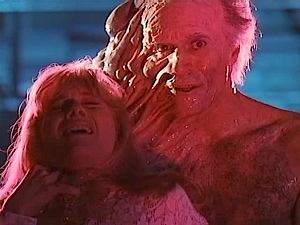
Dr. Pretorius has many monstrous forms, going through five different changes throughout the film, each more grotesque than the last.  In general, he's a slimy, pink mass of flesh and muscle, mixed with teeth and tentacles.   Also, he more or less resembles a penis, due to the extended neck that his head and face protrude from, not to mention all the slithery tentacles waggling around.  This phallic imagery can also be found in Crawford's (eventual) bald head and extended pineal gland.  This (sort of) subtle imagery seems to reinforce the stronger sexual themes that are present in the film, as the character's sexual desires are opened up as a result of using the resonator (they explain this by saying the pineal gland is connected to such things; it isn't).  Katherine and Crawford start to develop a connection, while Pretorius wants to make a connection with Katherine, to "open her mind up," as his sadistic sexual tendencies seem furthered since transforming.

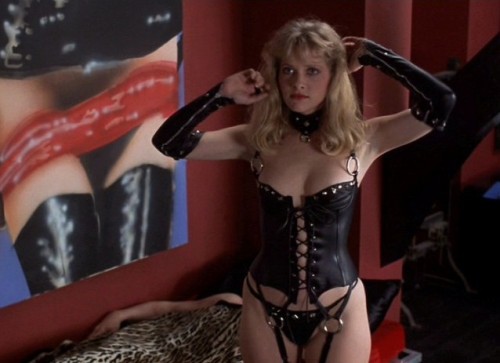
While still living, Dr. Pretorius was into S&M sex, so much so that he had a room in his house stocked with a bed, restraints, chains, mirrors, erotic art, and video recording equipment.  It's in this room that Katherine goes through a radical change after coming under the influence of the resonator, taking her glasses off, letting her hair down, and changing into a leather dominatrix outfit (one that she fits into perfectly).  It's not only a great character scene, watching her go from sultry vixen to being awash in shame (after some timely intervention by Bubba), but, I mean, c'mon, hubba hubba.
The special effects were accomplished by a team (as they usually are) of professionals, including John Naulin, Mark Shostrom, and John Carl Buechler.  Naulin was principal special effects artist on Re-Animator, and he designed the basement worm-monster that terrorizes Crawford and Bubba, which sort of resembles the monsters in The Deadly Spawn (1982).  Buechler did work on Re-Animator designing the zombies featured in the finale.  On From Beyond he was responsible for creature designs and the various incarnations of transformation that Pretorius goes through, supervising the mechanics needed to pull off such complicated effects.  It's fantastic effects work, probably the best visualization of a Lovecraftian nightmare put to film.  The transformations remind me of John Carpenter's The Thing (1982, effects by Rob Bottin) and, to a lesser degree, Brian Yuzna's Society (1989, effects by Screaming Mad George), although that one might have more to do with the color palette of the movie and the sliminess of the creatures.

The dominate color scheme of the film is pink, purple, and blue, all with a sickly neon hue.  As mentioned, the monsters are fleshy and slimy, and these candy colors gives it this slightly cartoony, EC Comic style look.  It enhances the otherworldliness of the violence, the horror, and the terrifyingly unreal monsters.  I find the film to be less goofy than Re-Animator, although there is definitely humor present (Bubba hams it up especially).  The humor is suitably black and maybe a bit dry, as seen in scenes where a little dog licks at the stump of a headless corpse, or later when you see the chalk outline of said body (sans head).
After the success of Re-Animator, director Stuart Gordon signed a three picture deal with Empire Pictures and producer Charles Band, a wise decision on Band's part, as Gordon is easily the best director to ever work for the company.  Gordon would relocate to Rome, Italy, where Empire had their studios located, and he would use some of the same crew and cast from his debut film, but most of the production was rounded out with Italian crewmembers.  Returning was screenplay writer Dennis Paoli, producer Brian Yuzna, cinematographer Mac Ahlberg, editor Lee Percy, composer Richard Band, and others.  Both Jeffrey Combs and Barbara Crampton would return, this time both playing very different characters than the last go round.

Gordon was interested in doing a series of Lovecraft films, similar to Roger Corman's Edgar Allan Poe films.  This idea wouldn't quite take off, but Gordon would return to the concept with Combs and Crampton for Castle Freak (1995) and would also adapt Lovecraft with 2001's Dagon (a film originally intended to be his Re-Animator follow-up) and his Masters of Horror entry Dreams of the Witch-House from 2005.
Jeffery Combs plays an altogether different kind of weird scientist in this film.  As Herbert West, Combs was brash and bold, but as Crawford his intenseness is compounded by his troubled meekness.  Combs can somehow credibly and believably deliver a line of dialogue like "He bit off his head. . .like. . .a gingerbread man!"  Crawford eventually becomes incredibly unhinged and acts erratically after his pineal gland emerges from his forehead.  Despite becoming a murderous, eye-sucking monster, Crawford still retains a bits of humanity, displaying remorse and a bit of self-loathing.  His final confrontation with Pretorius is equally horrific and outrageous in its execution.  Other than his films with Stuart Gordon, Jeffrey Combs can be seen in The Frighteners (1996), House on Haunted Hill (1999), The Attic Expeditions (2001), and the new horror flick, Would You Rather (2012).

Compared to Megan in Re-Animator, Barbara Crampton has a much more substantial role as Dr. McMichaels.  As I mentioned above, she has a good character arc, with clear motivations.  She ignores the obvious danger potential of the resonator, becoming fixated on the idea that it could be used to diagnose and treat schizophrenia patients, an obsession of hers due to her father (a schizo) who died in a mental hospital.  I love how Katherine, in great horror movie tradition, is left broken and crazed at films end.  I can't say I've seen all of Crampton's work (such as her reoccurring roles on soap operas Young & the Restless and Bold and the Beautiful) but I think it might be safe to say that this is her finest performance.
Ted Sorel is a pretty great villain, giving Pretorius a threatening grandiosity.  In the tradition of great villains, he thinks of himself as a supreme being, as the pinnacle of existence.  His ego is only matched by his monstrous tendencies, such as in one of the more audacious scenes in the film, where Pretorius grabs Katherine and proceeds to molest her with his just-grown tentacle fingers (ewww).  Sorel would have small roles in Lenny (1974) and Network (1976) before settling into a career mainly consisting of television guest-star work.  Along with Barbara Crampton,  From Beyond is, without a doubt, his career highlight.

Ken Foree is a genre favorite, his most legendary role being that of iconic badass Peter in Dawn of the Dead (1979).  As policeman (and former football player) Bubba, Foree plays it loose and jovial, displaying bravery and showing true character.  He also wears some of the littlest red shorts ever to be seen in a motion picture, in full display during the battle with the basement monster.
From Beyond doesn't have quite the reputation or cult following that Re-Animator has, which is a shame, as it is every bit as entertaining as its predecessor and maybe more daring in its depiction of Lovecraftian nightmare visuals.  It definitely outdoes Re-Animator in terms of sheer whatthefuckery.  If you're a fan of Lovecraft, practical special effects, gooey monsters, and/or weird scientific terrors, then you owe it to yourself to check out From Beyond, guaranteed to deliver on all fronts and on the promise that "humans are such easy prey."
*This trailer for From Beyond features a lot of the cool special effects and other crazy shit, but is also fairly heavy on SPOILERS, so proceed with caution:

Commerce section:
From Beyond was just released this week on a new Blu-ray/DVD combo pack from the fantastic folks over at Scream Factory (subsidiary of Shout! Factory).  Packed full of special features, including commentaries, interviews, and more(!), the transfer looks great, the colors really pop, and you can see every dripping glob of goo.  I noticed the detail during the bug storm scene was remarkable; you could really see those little buggers.  If you're into it, you should totally buy yourself a copy.  I know I will be.
Random thought:
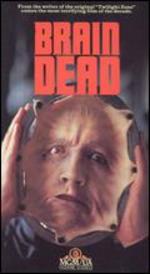
Being a child of the 80s, I used to cruise up and down the aisles of the video store, looking at vivid box art in the horror section and just imagining what kind of stuff was in these movies, and the From Beyond VHS cover was so lurid and in-your-face that it definitely stood out to me.  For some reason though, when I was younger I used to associate the title of From Beyond with Brain Dead (1989) and (to a lesser extent) Altered States (1980), simply because I thought they all had similar box covers (at least at the time):

I guess this style of VHS box can be called the "close-up of a weirdo's face" style of box art.  I like it.