Showing posts with label Sid Haig. Show all posts

Sunday, August 31, 2014

Pit Stop


Raw Guts For Glory!  Flesh Against Steel!


Jack Hill's 1969 auto-racing exploitation movie Pit Stop (filmed in 1967, produced by Roger Corman) is full of real race car action and plenty of fender crunching crashes and even features a couple memorable performances from its cast (one of who would be a future Oscar winner), not to mention the cool blues-rock soundtrack, groovy laid-back 60s vibe, and, hey!, lots of squealing tires on dirt. . . basically what I'm getting at is that this is another winner from exploitation writer/director extraordinaire Jack Hill.

Fun fact:  the original title for this film was The Winner.


Pit Stop follows tough-guy, drag racing loner Rick Bowman (Richard Davalos) who gets bailed out of jail by an unscrupulous promoter and car sponsor named Grant Willard (Brian Donlevy) and pulled into the world of figure-8 racing, which is exactly what the name implies: a looped-track race with an intersection.  It's crazy, but apparently exists in the real world.


Rick goes up against the hotshot local, wild driver Hawk Sidney (frequent Hill collaborator Sid Haig) and they develop a rivalry on the racetrack and off, some of it involving Jolene (Beverly Washburn), Hawk's dark-haired, wide-eyed groupie girlfriend (but as she says to Rick, she's "nobody's girl.")

Eventually Rick proves to be the better driver and Grant gets him into bigger races, real races, as a backup for Grant's ace driver, Ed McLeod (George Washburn), but Rick gets himself into further romantic trouble with Ellen McLeod (Ellen Burstyn, credited under her surname McRae), Ed's wife.
On paper, all of that seems pretty routine stuff for this kind of movie.  In practice, you got a whole different machine.
Here, let me give you 10 Reasons you should roll on over to the PIT STOP.


1.  Jack Hill, exploitation luminary.

In an interview once, Quentin Tarantino called Jack Hill the "Howard Hawks of exploitation movies," and the label has stuck over the years and that is because it's true and accurate.  Just like Hawks, Hill was adept at working in many different genres, all of them confidently.

While Hawks made A-list-type films in the war, drama, comedy, and western genres, Hill of course would make B-pictures (but stellar B-pictures) in genres as varied as horror (Spider Baby [1967]), blaxploitation (Coffy [1973]Foxy Brown [1974]), fantasy (Sorceress [1982]), women-in-prison movies (The Big Doll House [1971], The Big Bird Cage [1972]), girl gang action-dramas (Switchblade Sisters [1975]), and cheerleader flicks (The Swinging Cheerleaders [1974]).

Whatever material he worked with, Hill was able to elevate it.  He often wrote his own movies (as he did with Pit Stop), imbuing them with realistic and snappy dialogue and giving the film a specific rhythm (also with the editing, which Hill happened to do on this movie as well) that keeps things lively with a forward momentum.  It kept his movies from becoming run-of-the-mill drive-in fare and is part of the reason why his films are still enjoyable today and continue to be influential.


2.  The cinéma vérité style shooting, the realism, clever editing, & montage.
The first half of the movie features plenty of figure-8 racing and car crashes, all of which is exciting to watch.  The races were filmed at a real racetrack during actual races, documentary style with five cameras, led by director of photography Austin McKinney.  This guerrilla-style of shooting adds to the authenticness that runs throughout the film, a realism that is accentuated by the use of handheld cameras during the action scenes.

The real race footage is cleverly and seamlessly spliced into the scenes of the actors, most of which was filmed on sets and in non-race locations.  The editing is so superb that it is hardly noticeable and not nearly as jarring as similar tactics usually are on low budget pictures like this one.
The junkyard location, where Rick fixes up his cars and whatnot, usually in groovy montages, is also very cool and is definitely another highlight.  Hill and his crew really maximize the location for production value, with piles and piles of junked out classic cars, ruined from recklessness, that not only look cool onscreen but also perfectly echo the possibilities of living in the fast lane of race car driving.

3 & 4.  Sid Haig and Beverly Washburn.

Sure, Rick is the star of the movie and the main character (and actor Richard Davalos did play James Dean's brother in East of Eden [1955]...), but these two steal the show!  Haig, playing Hawk, is a wild man, with crazed eyes and facial expressions and an almost manic way about him.  He's a lively fella.

In some of the later scenes though, you get the idea that his bravado might be a coverup for some feelings of insecurity.  Haig plays the role large and is great fun to watch.  In a fun bit of trivia, Haig didn't know how to drive a car when he took the role of the fearless-driving Hawk.

His lady friend, Jolene, as played by Washburn, is equally fun to watch in a completely different way.  She's a gum chewing, dark-haired dish who does most of her acting with her expressive eyes.  She's kind of a weirdo in early scenes where she's hanging on Hawk, but later on there's real empathy for the character and the situation that she finds herself in.
One of the best scenes is when Hawk, sore over losing a race AND Jolene to Rick, heads out and gleefully smashes Rick's car up with an axe. . . while Jolene is cowering inside!  It's an intense scene, made more so by the frantic in-your-face handheld camerawork.

At this point in 1967, when this movie was filmed, Sid Haig and Beverly Washburn were part of Jack Hill's acting repertory.  Haig would work on most of the films Hill made; he and Washburn both starred in the excellent Spider Baby, which was filmed in 1964 but not released until 1967.

Fun Fact: Haig and Washburn both had roles on Star Trek: TOS, in Season 1's "The Return of the Archons" and Season 2's "The Deadly Years," respectively.
And of course, there's Jolene's "Why Not?" t-shirt...

5.  future Oscar winner, Ellen Burstyn.
This is one of Burstyn's first film roles and she makes the most of what is basically a wire-thin part as the neglected wife who is nevertheless devoted to her husband's work (she helps with the welding and engine work).  She's very restrained in her performance, and with that she brings a certain dignity to the character, a dignity that informs her later misguided attraction to Rick.

It's a wonderfully understated performance, she's fantastic, making an impression with her limited screen time.
Ellen Burstyn would, just a couple years after Pit Stop, star in Peter Bogdanavich's The Last Picture Show (1971) and receive her first of six Oscar nominations.  She would win a few years later for Scorsese's Alice Doesn't Live Here Anymore (1974) and she would also star in The King of Marvin Gardens (1972), Requiem for a Dream (2000), and, most famously, The Exorcist (1973).

I also have to mention she was a multi-episode guest star on season 4 of Louie, which was excellent.

6.  The cool blues-rock soundtrack.

The instrumental soundtrack is provided by a band called The Daily Flash, a psychedelic surf blues rock group.  Actually, it is just credited to them, as that band broke up before the movie came out and the soundtrack was recorded by some former members of The Daily Flash, as a group called Two Guitars, Bass, Drums, & Darryl.  Either way, the tunes are groovy and they really play well over the montage scenes.

Here's one of the tracks over a series of production stills.  Dig it:


7.  The dune buggy scene.


Dune buggies are cool.  These scenes were filmed at the Imperial Sand Dunes in Southern California, where dune buggy vehicles like the ones featured in Pit Stop are no longer legal to drive due to safety and environmental concerns.  Smaller and safer ROVs are allowed, but nothing like these hotrods here.  This short section of the movie is like a small peak into a bit of regional history.  Plus, you know, dune buggies..

8.  The car crashes - lots of em!
Crash, bang, smash.  If you like cars crashing into one another, this has got you covered.  The figure-8 racing is crazy and a lot of real crashes are captured in the movie.  Nobody was seriously injured while filming so you can enjoy the carnage guilt-free, which is good, because the mayhem is quite entertaining.

9.  The downbeat, somewhat existential, bummer ending.

I did not see that coming.  Sheesh.
Pit Stop ends with a downer of an ending, flipping the definition of a hero with Rick revealing his true character (and Grant, too), further defining his position as an outsider-loner whose selfishness is clearly self-evident (Grant just cements himself as the oily promoter).

I won't spoil the specifics of the ending of the movie, just know that it is decidedly downbeat and quite fitting for the era it comes from.  It brought to mind two wildly disparate things; the endings to both George A. Romero's Night of the Living Dead (1968) and Monte Hellman's Two-Lane Blacktop (1971).  Make of that what you will.

10.  The cool Crash-o-Rama movie trailer!

And here is the trailer again, but with Jack Hill commentary, courtesy of Trailers From Hell:


Final Thought:  Pit Stop is a great little auto-racing, 60s rock n' roll, delinquent, exploitation, action-drama, rising above its low budget and generic genre premise.  If you see it on your travels, be sure to stop and check it out.
"Is there anywhere in the world there isn't old beer cans?"
Yeah, maybe there would be if you stopped throwing your empties everywhere, ya dink!

Sunday, February 24, 2013

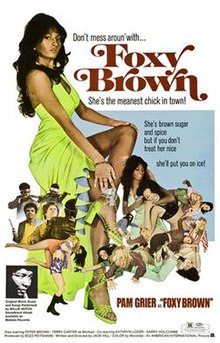
Foxy Brown

After the success of Coffy in 1973, director/writer Jack Hill hurried into production a follow-up film.  Released just 9 months later, Foxy Brown (1974) isn't a direct sequel to Coffy, but it does once again star Pam Grier as a woman out for revenge against those that have done her wrong.


While Foxy Brown doesn't quite match up with Coffy on some levels, the two films helped establish Pam Grier as an icon of '70s soul chic and would go on to inspire similar female-starring blaxploitation pictures like Sugar Hill (1974), TNT Jackson (1975), and Velvet Smooth (1976), amongst others.

Foxy Brown does outdo its predecessor in a couple areas, namely the opening credits sequence (done with psychedelic '70s colors and Pam Grier doing kung-fu dance moves) and the theme song and musical score by Willie Hutch (The Mack, 1973), which brings the soul-funk and keeps it there so it rattles in your eardrums.  Lots of wah-wah, strings, and flutes.  Fuck, I love flutes.


Foxy has two problems in her life: her brother and her boyfriend.  Her ambitious brother Link (Antonio Fargas) is a no-good, habitual criminal and loser she has to constantly bail out of trouble.  Her boyfriend Michael (Terry Carter) is another kind of trouble.  He and Foxy care about each other very much, but he's an undercover government agent trying to bust a drug syndicate, which puts him in direct danger.  After going through an operation to change his appearance (and name to Dalton), Foxy hides him at her apartment, but unfortunately his path crosses with Link's, who figures out who he is really, and sells him out to the syndicate.  Michael/Dalton is shot down on Foxy's front porch, which commences the need for Foxy's revenge.

She finds that the murder is connected to a "modeling agency" ran by kinky weirdos Steve Elias (Peter Brown) and Miss Katherine (Kathryn Loder), so she decides to pose as a prostitute and infiltrate the agency.  On her first job, she meets another prostitute named Claudia (Juanita Brown) who wants out of the business, and who is more than willing to help Foxy take Miss Katherine down.  After the pair of them embarrass a client (an old judge who has at thing for black chicks) they hide out in a lesbian bar, but the lesbians take a liking to Claudia.  This leads to a barroom lady-brawl which features face slaps, pulled hair, broken bottles, a smashed jukebox, and Foxy throwing chairs around, proclaiming she's got "a black belt in barstool."  It's a cool scene, but it doesn't quite compare to the catfight in Coffy.  (i.e. no tops are ripped off).

After escaping the lesbian bar, Foxy and Claudia are both captured by Katherine's goons, and Claudia is hauled away (we never see or hear about her again).  Foxy is beaten, tortured, and sent to "the ranch," one of their drug labs.  There she is bound to a bed, guarded by two hicks, forced to take heroin, abused, and raped.  She manages to escape and exact her fiery revenge on her tormentors, before fleeing and contacting members of a street gang and enlisting their assistance in finishing the job she started.

It's in this section that we see the biggest differences between Coffy and Foxy Brown.  Coffy was never a victim and she was fiercely independent, never calling on the help of any men to help her.  These qualities helped lay the foundation for Coffy (and Pam Grier) as a symbol and role model of feminine empowerment.  Conversely, Foxy is victimized, abused, and forced to take drugs.  Even though she escapes on her own accord, and she is shown many times as a strong and empowered woman, she does enlist the help of a squad of men to help her finish her task.  The presence of this street gang, while needed somewhat, seriously diminish the power that she holds as a solo vigilante.

Jack Hill regular Sid Haig has a fairly small part in this film (especially compared to Coffy), maybe less than 15 minutes screen time, as a pilot named Hays who works for the drug ring.  After Foxy hooks up with the street gang, she sets her plan in motion by seducing Hays and convincing him to let her join him in Mexico while he makes a drug drop.  She of course steals the plane and uses it to do some serious damage to some thugs, but none of it is as nasty as her ultimate revenge on Elias and Miss Katherine.

Pam Grier once again combines her likability and good looks with a kickass, no-nonsense attitude.  The costume designers went the extra mile in this one, giving Pam some remarkable outfits that really helped define her as a pop culture icon.  She retains her sexiness without ever being as naked as she was in Coffy, but don't worry, there's plenty of skin in the film.

Antonio Fargas is probably best known as Huggy Bear on televison's Starsky and Hutch.  He's also featured in Shaft (1971), Across 110th Street (1972), Cleopatra Jones (1973), and Car Wash (1976).  The same year as Foxy Brown, Terry Carter would also star in the blaxploitation/Exorcist rip-off Abby and the family classic Benji, but he's probably best known for his roles on popular '70s television shows like McCloud (Sgt. Broadhurst) and the original Battlestar Galactica (Col. Tigh).

Kathryn Loder also starred with Pam Grier and Sid Haig in Jack Hill's The Big Doll House (1971).  Juanita Brown was busy in 1974, also starring in Willie Dynamite, Black Starlet, and Jonathan Demme's Caged Heat (her only film credits).  Peter Brown would star in the mean and salacious Rape Squad (1974) and was also in Kitten with a Whip (1964), a film featured on the sixth season of Mystery Science Theater 3000.


Foxy Brown is a meaner and nastier film than Coffy, and maybe a little less coherent (the quick production probably has a lot to do with that), but it's still a fun exploitation film that is required viewing for fans of '70s cinema or blaxploitation films.  That ain't no jive.

Saturday, February 23, 2013

Coffy


In celebration of black excellence during this month of history, let's talk about some blaxploitation films.  You dig?

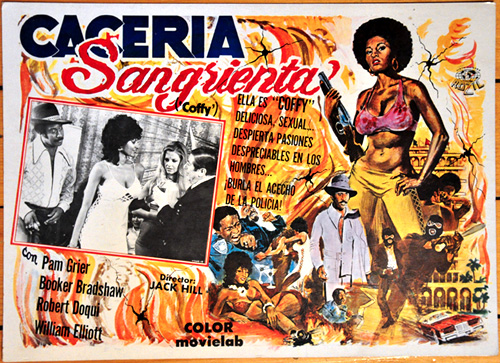
First up is one of my favorites, a classic of the genre, Coffy, a 1973 revenge film starring genre icon Pam Grier as a vigilante "one-woman hit-squad" out for justice against the pimps and the drug pushers.  As one of the many ingenious taglines phrases it, "No one sleeps when they mess with Coffy!"

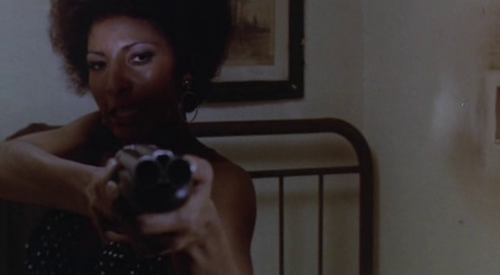
The film has a dynamite opening that readily establishes the two major components of the film: action and sex appeal.  Coffy is already on her hunt for vengeance, pretending to be a junkie to seduce this mid-level drug dealer, before grabbing her shotgun and blowing the guy's head clean off.  It's not a Scanners or Dawn of the Dead level of headshot (no fountains of blood), but it is more than effective in setting the tone for the rest of the film, and for Coffy as a no-nonsense, singularly focused vigilante.

Why is Coffy out for revenge?  Well, it seems some drug dealer types got her little sister hooked on heroin, landing her in a rehabilitation home.  Coffy is no stranger to what the drug trade and mobsters are doing to the community, as she has experience treating victims of violence at her day job at a local hospital where she's a nurse.  She tries to confide in a former boyfriend Carter (William Elliot), a straight and by-the-book cop, who is facing his own battles with corruption on the police force, but after Carter is severely beaten in his home by a couple of mob thugs, Coffy's resolve for vengeance is fortified even further.

Coffy finds momentary comfort with her current boyfriend, Howard Brunswick (Booker Bradshaw), a city council member considering running for Congress.  He's a socially conscious politician who seemingly wants the best for the community.  He also seemingly loves Coffy, and she seems to love him.  She is at her most feminine and vulnerable with him, but she doesn't tell him what she's done or what she plans to do.  Which is maybe a good thing, as she plans on infiltrating a prostitute ring in an effort to further her vengeance.  Even the most understanding boyfriend might have trouble with that one.


This prostitute ring is ran by a pimp named King George (Robert DoQui), one of the cities largest providers of illicit flesh and illegal substances, who is working for a mafia boss named Arturo Vitroni (Allan Arbus).  Coffy decides to pose as a prostitute, first gaining insight into what kind of women King George likes by questioning Priscilla (Carol Locatell), a former patient of hers (and prostitute of theirs).  Coffy slaps the shit out of this lady, threatening her with a broken bottle, showing little remorse as Priscilla has obviously lapsed back into drug abuse.  This scene provides one of the more comedic moments of the film though, as Priscilla's "old man" Harriet shows up and starts smashing chairs and threatening Coffy.

King George takes an instant liking to Coffy (pretending to be a Jamaican named Mystique).  He brings her back to his house, but the other girls don't seem to appreciate the sudden intrusion, especially Meg (Linda Haynes), who seems to be the King's #1 lady.  Later at a party thrown for Vitroni, Meg purposefully knocks some drinks onto Coffy, which of course leads to an all out female brawl.  Like all good catfights, hair is pulled, faces are slapped, and tops are ripped off.  Coffy goes the extra mile, having hid razors in her afro, which slice up Meg's hands when she goes to rip her hair.  King George and Vitroni are both impressed, as they should be.  It's one of the best scenes in the movie.

Left alone with Vitroni (who is a sadistic racist), Coffy attempts to shoot him, but is stopped by Omar (Sid Haig), one of his vicious thugs.  In an effort to pit them against one anther, she lies to Vitroni and says that King George hired her to murder him.  The mob being the understanding guys that they are, they then take King George for a ride before throwing a noose around his neck (!) and dragging him through the streets behind a Cadillac.  It's one of the more viscous and racially charged scenes in the movie.

As time runs out on Coffy, she is captured, locked up, and faced with the truth of how deep corruption runs in her city.  The bad guys count her out, but when she breaks out, all hell breaks loose.


Released in 1973, during the boom in blaxploitation pictures, Coffy was unique, not only for its anti-drug message, but in that it starred a woman as the central hero.  Her vengeance is both personal and societal, she fights for her sister and her community at large.  Neither a criminal (at least prior to her murder spree) nor a victim, Coffy is an independent woman who is smart, strong, and resourceful, all in addition to being drop dead sexy.  Her look is iconic, big afro and alluring curves.  Grier does a good job carrying the movie (she's in almost every scene), even though some of her acting is raw.  She does occasionally display her natural and very likable personality, although not as often as she bares her natural and very likable breasts.  (I'm not complaining, I just have to say it.)

Pam Grier would get her start with a small role in Beyond the Valley of the Dolls in 1970.  Director/writer Jack Hill instantly recognized that she would be a star and cast her in slightly larger, but still supporting roles in both The Big Doll House (1971) and The Big Bird Cage (1972), two "women in prison" films.  Hill would write the role of Coffy specifically for Grier, and the movie would go on to be a great financial success (audiences loved it too).  Grier would go on to be one of the top stars of the blaxploitation genre, starring in Hill's follow-up, Foxy Brown in 1974, as well as Scream, Blacula, Scream (1973), Sheba Baby, Bucktown, and Friday Foster (all 1975).  As the genre would dry up after the '70s, Grier would make memorable appearances in Ray Bradbury's Something Wicked This Way Comes (1983), Above the Law (1988), Class of 1999 (1990), and Escape from L.A. (1996).  She would make what is considered her best picture in 1997, Quentin Tarantino's Jackie Brown, itself a partial homage to blaxploitation films, as well as being a role that was written specifically for Grier.

Director Jack Hill is one of the best directors of exploitation pictures, displaying economy, excitement, and variety in his storytelling, something that stood out on the exploitation circuit.  He would get his start working for Roger Corman, doing uncredited work on films like The Wasp Woman (1960) and The Terror (1963, parts of which were used for Targets), and shooting US scenes for Mexican movies like House of Evil and The Snake People (both 1971).  His 1964 weird and wonderful horror film Spider Baby would go unreleased until 1968 and wouldn't gain any sort of notoriety until 25 years later.  Hill would gain steady directing jobs starting in 1971, with The Big Doll House, which would be the first of 4 collaborations with Pam Grier, followed by The Big Bird Cage, Coffy, and Foxy Brown.  Hill would also write and direct The Swinging Cheerleaders (1974) and Switchblade Sisters (aka: The Jezebels, 1975), which is another legitimate exploitation classic.  In addition to discovering Grier and Sid Haig, Jack Hill would also discover Ellen Burstyn, future Oscar nominee and winner (The Exorcist [1973], Alice Doesn't Live Here Anymore [1974]), casting her in his 1969 racing movie, Pit Stop.


Veteran character actor Sid Haig would get his start in Jack Hill's short student film The Host in 1960.  Haig would be memorable for his bald head and his gruffness, and he would work with Hill on 7 more pictures, 4 of those with Pam Grier.  He would also star in George Lucas' THX 1138 (1971), Black Mama, White Mama (1973, also with Grier), Galaxy of Terror (1981), along with a plethora of television shows from the 70s/80s.  He's probably most famous now for his role as Captain Spaulding in Robert Zombie's House of 1000 Corpses (2003) and The Devil's Rejects (2005), in which he is far and away the best thing in both movies.

The pimp costumes that Robert DoQui wears are so flamboyantly awesome that they should go into the pimp hall of fame.  DoQui would go on to star in Robert Altman's ensemble drama Nashville (1975), as well as all three Robocop movies as Sgt. Warren Reed.  Alan Arbus is probably best known as the shrink that would visit the cast of the hit TV show M*A*S*H, and William Elliot would fight giant killer rabbits in Night of the Lepus (1972).  Linda Haynes would play William Devane's poor wife in Rolling Thunder (1977) and Carol Locatell (credited as Lawson) would go on to play mean, old Ethel in Friday the 13th: A New Beginning (1985).

The soundtrack (by Roy Ayers) has the requisite funk and vibe of the genre, but in general it fails to reach the iconic heights of Across 110th Street (Bobby Womack), Shaft (Issac Hayes), or Super Fly (Curtis Mayfield).  Cinematographer Paul Lohmann (whose energetic and efficient work on Coffy is only hampered by the poor lighting) would go on to work with Robert Altman on California Split (1974) and Nashville, as well as with Mel Brooks on Silent Movie (1976) and High Anxiety (1977), and shoot the atmospheric Charles Bronson western The White Buffalo (1977), and the scathing Joan Crawford biopic Mommy Dearest (1981).  Set decorator Charles B. Pierce would go on to his own career in exploitation pictures, helming, The Legend of Boggy Creek (1972), The Town that Dreaded Sundown (1976), The Evictors (1979), and Boggy Creek II: The Legend Continues (1985; a movie so bad, it was featured on the final season of Mystery Science Theater 3000).


Coffy is a great low budget exploitation picture, fulfilling on its promise of action and sex, and a must see for fans of '70s cinema.  You got to give it up for "the Godmother of them all!"

Also:  I believe Coffy contains a scene with a car squealing its tires on dirt, but honestly it's a fairly murky and dark scene, so it's hard to tell definitively whether it's a dirt road or not, but I'm going to call it:

CONTAINS:  Squealing Tires on Dirt