Showing posts with label blaxploitation. Show all posts

Saturday, February 22, 2014

Sheba, Baby

In honor of Black History Month I wanted to once again review some blaxploitation films, as I find it to be one of the most vibrant and interesting of exploitation subgenres and that usually even the mediocre films are worth discussing.

First up in the discussion, the Pam Grier starring, William Girdler directed, Sheba, Baby (1975).

-Count the commas in this post and win a prize!*
Up front I have to tell you that this is a lesser Pam Grier blaxploitation film.  Despite what the tagline claims, Sheba, Baby is not as strong when compared to her previous classics Coffy (1973) and Foxy Brown (1974), as it tones down the sex, violence, and even the swearing that fans of Ms. Grier's previous efforts had come to expect.  The action scenes are also less dynamic, coming off a little flat and maybe even a bit goofy (especially the hand-to-hand, fist-fight stuff).


This would be one of Grier's final blaxploitation films (it was actually her last film under contract with AIP) and you get the sense that she was sort of done playing these types of roles.  You can see her just going through the motions in a couple scenes and her dialogue doesn't have much punch to it, but maybe that's just due to the way it was written..


Despite it's flaws, I did find Sheba, Baby to be a fun, rainy afternoon watch (which it was).  It has some memorable moments and supporting characters and the location shooting in Louisville and Chicago are interesting if you're from the Midwest (which I am) or maybe even if you're not.


The plot of Sheba, Baby goes like this:  Young, female Chicago detective Sheba Shayne (Grier) is called back to her hometown of Louisville, Kentucky to help her father, a local businessman who is being threatened by the mob.  Sheba has to put her detective skills to use and bust some heads as she works her way up the ladder of the crime syndicate.  Along the way she romances an old acquaintance and her father's current business partner, Brick Williams (Austin Stoker).
Stoker is good in this, he's sort of casually cool, with a bit of squareness in there, but he doesn't really amount to much more than "romantic interest" in the movie.  It's what you would expect from a guy named 'Brick.'  I like the guy though; Stoker was in John Carpenter's Assault on Precinct 13 (1976) and also Battle for the Planet of the Apes (1973), not to mention a couple earlier films with director William Girdler, one of which was Abby (1974), otherwise known as The Blaxorcist (check out my review here).
The bad guys seem to be very typical of blaxploitation movies, but they're good and serviceable.  D'Urville Martin, who is always good and memorable, plays the mid-level, local crime boss Pilot, and he does it big and bold.  He of course plays it a bit more subdued when he's around the big villain/his boss, a white businessman named Shark (Dick Merrifield).  Shark is a slimy land developer or something…I don't remember.  He's a real jerk though, cold, cruel, and a bit smug.


Other than Sheba, Baby, Dick Merrifield's only other claim to fame would be a pair of supporting roles in movies featured on MST3k, The Hellcats (1968) and The Sidehackers (1969), both of which are motorcycle flicks.


Like I said, D'Urville Martin is always good and he had a nice career in blaxploitation films; the same year as Sheba, Baby he played Willie Green in Dolemite.  Interestingly, one of Martin's earliest roles was Diego, the elevator operator in Rosemary's Baby (1968).


Maybe the most memorable supporting character, and easily my favorite, is Walker the pimp (Christopher Joy), who might not be a literal pimp, but I can't help but refer to him as such.  He runs a pawn shop out of his car and pretty much single handedly fills the movie's jive-talk quotient.  Sheba leans on him for information and while he's cocky at first, he proves to be a coward and gives up the info.


Joy is a lot of fun in the role; he's what you think of when you think "70s movie pimp" and he is a highlight of the movie.  He would play Curtis the pimp, virtually the same character, in Cheech and Chong's Up in Smoke (1978).


Backing up a minute, I also gotta mention Pilot's right hand man, Killer (Maurice Downs).  He doesn't do much really, other than be stern faced and appear to be without the capacity for joy, but there is this one scene where Pilot is giving a speech in front of his goons (and his ladies too, for some reason), addressing the Sheba situation, and this Killer guy is sitting behind Pilot chiming in with a "that's right" every two seconds.  It's funny and weird that there was emphasis put on this character quirk.  I like it.
"That's right."
The original musical soundtrack is pretty good, maybe not as iconic as the scores from Coffy or Foxy Brown (by Roy Ayers and Willie Hutch, respectively), but still solid.  The music was composed and recored by Monk Higgens, legendary Chicago saxophonist.  I like it.  It's funky.  Check it:

This was writer/director William Girdler's fifth feature film and, following the relative success of Abby, this was the first time he had a decent budget to work with.  Girdler never made big budget movies, but this is definitely when his career took a step up the quality B-movie ladder.  Sheba, Baby is not overly exciting visually, but the movie looks okay and there are some noteworthy sequences, namely the boat chase during the climax.  Pam Grier in that wetsuit and riding around on that old school jet ski is something to see too.
There's another memorable scene where Sheba is chased by Pilot's goons through the grounds of the Kentucky State Fair.  The rides and the people are interesting to look at, especially since the people in the background are mostly looking directly at the camera.  This happens in another scene too, when Brick and Sheba are having a nice romantic walk together.  It's like the people in Louisville freeze when faced with a camera.
I had mentioned that the action scenes aren't all that exciting, but there is one stunt that I thought looked kind of dangerous.  During this scene, Sheba is running up a grassy hill when a car full of bay guys comes driving over the top and looks like it comes very close to hitting her.  Could just be the camera angle, still looked dangerous to me.
Overall I would say that Sheba, Baby is a minor work and that anybody new to the blaxploitation genre should start with another movie.  Also though, I would say that if you are familiar or a fan of the genre and you haven't seen Sheba, Baby, I would suggest checking it out.  It's like a cleaner, Saturday afternoon version of a blaxploitation movie, but taken on its own terms, it's not bad and can be an enjoyable watch.  Dig it.


*No prize for counting commas.

Wednesday, February 27, 2013

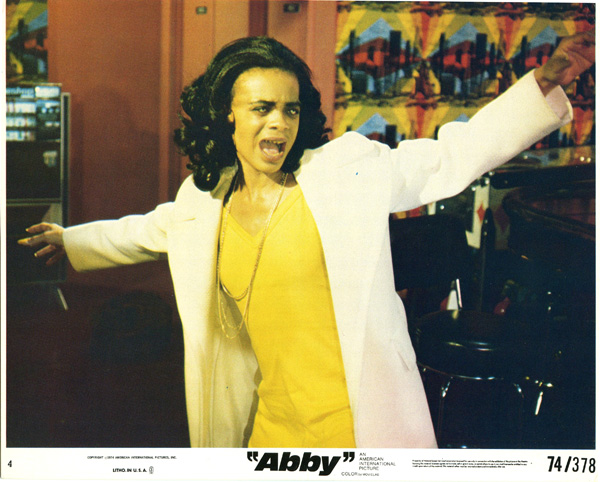
Abby

In the summer of 1973, William Freidkin's The Exorcist was unleashed to theaters and onto the general public.  The subsequent storm of publicity, controversy, and ticket sales resulted in Oscar nominations and recognition as one of the biggest films of the year.  It didn't hurt that is was also pretty damn scary.  The popularity of the film of course meant one thing:  knockoffs.

They came from around the globe, Turkey (Seytan), Italy (Beyond the Door), Spain (The Possessed), and Mexico (Alucarda), but right here in America we had one of the more infamous Exorcist knockoffs, if only for the resulting lawsuit.  Released in 1974 (on Christmas Day, no less), Abby is a possession film that supposes one thing differently than The Exorcist:  what if it happened to black people instead?  Ostensibly remaking The Exorcist as a blaxploitation film (an early working title for the film was The Blackorcist, I shit you not), Abby is a shameless attempt at cashing in on the success of Friedkin's film.  It's not a very good movie, but I'm going to talk about it anyway.

After a fairly static, expository opening scene (set in a very nice city park) the film flashes to Egypt, where Bishop Garnet Williams (William Marshall) is on an archeologic dig searching for information on the God Eshu.  Uncovering an old dusty idol, Bishop Williams accidentally unleashes the evil spirit of Eshu into the world.  The spirit manifests itself as a wind storm, blowing shit around and knocking people down as it escapes the cave.  Halfway across the world, the Bishop's son, Rev. Emmett Williams (Terry Carter) and his wife Abby (Carol Speed) are moving into their new home.  It's not long before that evil wind blows into the house, resulting in the spirit of Eshu possessing Abby.

Soon after, she is speaking in a lower octave, trying to cut herself with a knife, levitating off the floor, getting the crazy eye, and she even throws a guy through a door before she spits up foamy vomit on him.  Of course, this all plays second fiddle to the major change in Abby:  her sexual appetite.  It seems the evil deity of Eshu is a sex God, manifesting itself in Abby and turning her into a nymphomaniac.  This is a major problem for a preacher's wife.

Witnessing his wife trying to hump anything that moves (while speaking in a voice 3 pitches lower), the Reverend does two things:   inquire about her drug history to her brother, detective Cass Potter (Austin Stoker), and take her to the hospital where doctors run a bunch of tests on her.  She has no history with drugs and medically she's completely normal, but Abby gets all freaky when he takes her home to recover and she kills an elderly caretaker by giving her a heart attack.  After that, Abby escapes, and her husband, her brother, and the just-returned-from-Egypt Bishop Williams have to track her down and try to exorcise the demon.


Abby, being the horny demon she is, heads out to a local club, looking for some action.  First she picks up a guy and takes him out to his car to have sex, which of course gets a bit freaky (smoke starts pouring from the car interior, as (off-screen) the guy screams).  Abby then goes back inside and starts dancing and grooving with a pair of hip, tough-looking studs, but after her husband and brother show up, Abby starts throwing people all over the bar, over tables, and smashing the place up, before the Bishop appears and starts the exorcism process with the help of the Reverend and the detective.

Doning some ceremonial robes and engaging in verbal combat with the demon, the Bishop believes he is not actually dealing with the God Eshu, but rather a wannabe demon.  Whether this is the case or not, the movie sort of leaves ambivalent, but either way, after some levitation and some speaking-in-tongues (not to mention some real cheesy special effects), they eventually drive the demon out of Abby and send it back into the idol that it had originally escaped.


Like I said above, I don't consider this a good movie, even by exploitation standards.  Overall, the acting is okay, everyone seems to take it seriously, despite all the ridiculousness.  The story doesn't quite make sense, like how or why the demon flies from Egypt all the way to America just to possess Abby, or why her husband is such a bonehead.  The special effects are goofy, there's no real shocks or scares (no head-spinning), and the print of the movie is really rough looking, with the colors all washed out and muddy, not to mention the heavy amount of film scratches.

Abby does some wholesale lifting from The Exorcist by setting the opening in Egypt, emphasizing the power of faith, showing the befuddlement of the doctors, using levitation, vomit, and colorful language (she says "fuck" a lot), and by having subliminal flashes of the demon's face, which should be scary, but it unfortunately it looks like this:


What do you expect from a movie made for less than $200,000??  More silly than anything, Abby would still go on to be a minor hit, but it was pulled from theaters as Warner Bros. (owners of The Exorcist) sued (and won), claiming copyright infringement.  The WB took almost all of the profits from the film (close to $4 million) and the producers and writer/director William Girdler never saw a dime of money from the film.  (In this day and age, a lawsuit like that would never fly, or there wouldn't be half of the movies out on the direct-to-video market like there are).

Carol Speed would get the lead role in Abby after the original actress dropped out when her demands of an on-set masseuse were not met.  Speed would write and perform a song in the movie, "Is Your Soul a Witness?"  She also starred in Jack Hill's The Big Bird Cage (1972), The MackSavage! (both 1973), Black Samson (1974), and (one of my favorites) Rudy Ray Moore's Disco Godfather (1979).  If interested, you can read a good interview with her on the making of Abby over on her website HERE.

The same year as Abby, Terry Carter was also in the blaxploitation classic Foxy Brown.  Austin Stoker would also star in Battle for the Planet of the Apes (1973) and John Carpenter's amazing Assault on Precinct 13 (1976), as well as William Girdler's other two blaxploitation pictures: The Zebra Killer (aka The Get-Man, 1974) and Sheba, Baby (1975) with Pam Grier.

William Marshall was very vocal about his unhappiness with the production of Abby, as he was promised script revisions that never occurred.  He did however alter his own dialogue, adding much of the content in regards to the Yoruba religion of West Africa.  Marshall is best known today for two things: his titular role in Blacula (1972) and it's sequel, Scream, Blacula, Scream (1973) and as the beloved King of Cartoons on television's Pee-wee's Playhouse.


Director William Girdler was an expert exploitation filmmaker, making nine films in seven years, in genres like action, blaxploitation, and horror.  Some have called him the "king of the ripoffs," namely because of Abby and his 1976 film Grizzly, which is essentially "Jaws with claws." Such labels can be rather dismissive of the man and his work, and while the quality of his films may vary at best, his movies always deliver in the areas of excitement and "oh-shit-did-I-just-see-that?".  Even Abby, which is a lesser work for sure, still has a certain watchability just because it's unlike anything else you've seen.

Unless you've seen The Exorcist...

"Damn, Abby.  You crazy."

Sunday, February 24, 2013

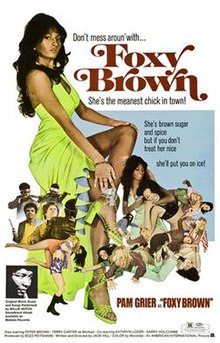
Foxy Brown

After the success of Coffy in 1973, director/writer Jack Hill hurried into production a follow-up film.  Released just 9 months later, Foxy Brown (1974) isn't a direct sequel to Coffy, but it does once again star Pam Grier as a woman out for revenge against those that have done her wrong.


While Foxy Brown doesn't quite match up with Coffy on some levels, the two films helped establish Pam Grier as an icon of '70s soul chic and would go on to inspire similar female-starring blaxploitation pictures like Sugar Hill (1974), TNT Jackson (1975), and Velvet Smooth (1976), amongst others.

Foxy Brown does outdo its predecessor in a couple areas, namely the opening credits sequence (done with psychedelic '70s colors and Pam Grier doing kung-fu dance moves) and the theme song and musical score by Willie Hutch (The Mack, 1973), which brings the soul-funk and keeps it there so it rattles in your eardrums.  Lots of wah-wah, strings, and flutes.  Fuck, I love flutes.


Foxy has two problems in her life: her brother and her boyfriend.  Her ambitious brother Link (Antonio Fargas) is a no-good, habitual criminal and loser she has to constantly bail out of trouble.  Her boyfriend Michael (Terry Carter) is another kind of trouble.  He and Foxy care about each other very much, but he's an undercover government agent trying to bust a drug syndicate, which puts him in direct danger.  After going through an operation to change his appearance (and name to Dalton), Foxy hides him at her apartment, but unfortunately his path crosses with Link's, who figures out who he is really, and sells him out to the syndicate.  Michael/Dalton is shot down on Foxy's front porch, which commences the need for Foxy's revenge.

She finds that the murder is connected to a "modeling agency" ran by kinky weirdos Steve Elias (Peter Brown) and Miss Katherine (Kathryn Loder), so she decides to pose as a prostitute and infiltrate the agency.  On her first job, she meets another prostitute named Claudia (Juanita Brown) who wants out of the business, and who is more than willing to help Foxy take Miss Katherine down.  After the pair of them embarrass a client (an old judge who has at thing for black chicks) they hide out in a lesbian bar, but the lesbians take a liking to Claudia.  This leads to a barroom lady-brawl which features face slaps, pulled hair, broken bottles, a smashed jukebox, and Foxy throwing chairs around, proclaiming she's got "a black belt in barstool."  It's a cool scene, but it doesn't quite compare to the catfight in Coffy.  (i.e. no tops are ripped off).

After escaping the lesbian bar, Foxy and Claudia are both captured by Katherine's goons, and Claudia is hauled away (we never see or hear about her again).  Foxy is beaten, tortured, and sent to "the ranch," one of their drug labs.  There she is bound to a bed, guarded by two hicks, forced to take heroin, abused, and raped.  She manages to escape and exact her fiery revenge on her tormentors, before fleeing and contacting members of a street gang and enlisting their assistance in finishing the job she started.

It's in this section that we see the biggest differences between Coffy and Foxy Brown.  Coffy was never a victim and she was fiercely independent, never calling on the help of any men to help her.  These qualities helped lay the foundation for Coffy (and Pam Grier) as a symbol and role model of feminine empowerment.  Conversely, Foxy is victimized, abused, and forced to take drugs.  Even though she escapes on her own accord, and she is shown many times as a strong and empowered woman, she does enlist the help of a squad of men to help her finish her task.  The presence of this street gang, while needed somewhat, seriously diminish the power that she holds as a solo vigilante.

Jack Hill regular Sid Haig has a fairly small part in this film (especially compared to Coffy), maybe less than 15 minutes screen time, as a pilot named Hays who works for the drug ring.  After Foxy hooks up with the street gang, she sets her plan in motion by seducing Hays and convincing him to let her join him in Mexico while he makes a drug drop.  She of course steals the plane and uses it to do some serious damage to some thugs, but none of it is as nasty as her ultimate revenge on Elias and Miss Katherine.

Pam Grier once again combines her likability and good looks with a kickass, no-nonsense attitude.  The costume designers went the extra mile in this one, giving Pam some remarkable outfits that really helped define her as a pop culture icon.  She retains her sexiness without ever being as naked as she was in Coffy, but don't worry, there's plenty of skin in the film.

Antonio Fargas is probably best known as Huggy Bear on televison's Starsky and Hutch.  He's also featured in Shaft (1971), Across 110th Street (1972), Cleopatra Jones (1973), and Car Wash (1976).  The same year as Foxy Brown, Terry Carter would also star in the blaxploitation/Exorcist rip-off Abby and the family classic Benji, but he's probably best known for his roles on popular '70s television shows like McCloud (Sgt. Broadhurst) and the original Battlestar Galactica (Col. Tigh).

Kathryn Loder also starred with Pam Grier and Sid Haig in Jack Hill's The Big Doll House (1971).  Juanita Brown was busy in 1974, also starring in Willie Dynamite, Black Starlet, and Jonathan Demme's Caged Heat (her only film credits).  Peter Brown would star in the mean and salacious Rape Squad (1974) and was also in Kitten with a Whip (1964), a film featured on the sixth season of Mystery Science Theater 3000.


Foxy Brown is a meaner and nastier film than Coffy, and maybe a little less coherent (the quick production probably has a lot to do with that), but it's still a fun exploitation film that is required viewing for fans of '70s cinema or blaxploitation films.  That ain't no jive.

Saturday, February 23, 2013

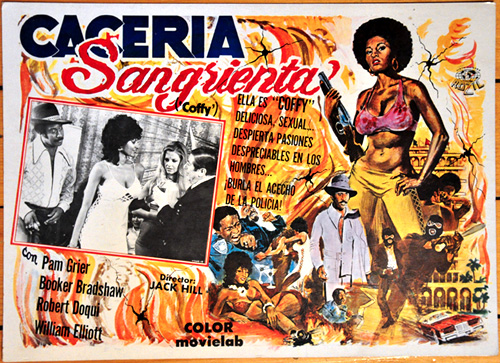
Coffy


In celebration of black excellence during this month of history, let's talk about some blaxploitation films.  You dig?

First up is one of my favorites, a classic of the genre, Coffy, a 1973 revenge film starring genre icon Pam Grier as a vigilante "one-woman hit-squad" out for justice against the pimps and the drug pushers.  As one of the many ingenious taglines phrases it, "No one sleeps when they mess with Coffy!"

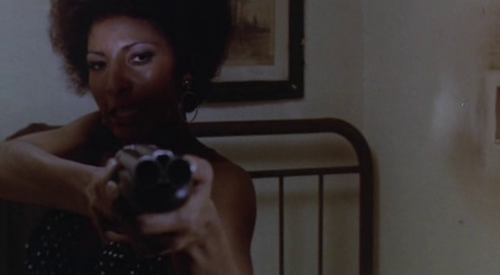
The film has a dynamite opening that readily establishes the two major components of the film: action and sex appeal.  Coffy is already on her hunt for vengeance, pretending to be a junkie to seduce this mid-level drug dealer, before grabbing her shotgun and blowing the guy's head clean off.  It's not a Scanners or Dawn of the Dead level of headshot (no fountains of blood), but it is more than effective in setting the tone for the rest of the film, and for Coffy as a no-nonsense, singularly focused vigilante.

Why is Coffy out for revenge?  Well, it seems some drug dealer types got her little sister hooked on heroin, landing her in a rehabilitation home.  Coffy is no stranger to what the drug trade and mobsters are doing to the community, as she has experience treating victims of violence at her day job at a local hospital where she's a nurse.  She tries to confide in a former boyfriend Carter (William Elliot), a straight and by-the-book cop, who is facing his own battles with corruption on the police force, but after Carter is severely beaten in his home by a couple of mob thugs, Coffy's resolve for vengeance is fortified even further.

Coffy finds momentary comfort with her current boyfriend, Howard Brunswick (Booker Bradshaw), a city council member considering running for Congress.  He's a socially conscious politician who seemingly wants the best for the community.  He also seemingly loves Coffy, and she seems to love him.  She is at her most feminine and vulnerable with him, but she doesn't tell him what she's done or what she plans to do.  Which is maybe a good thing, as she plans on infiltrating a prostitute ring in an effort to further her vengeance.  Even the most understanding boyfriend might have trouble with that one.


This prostitute ring is ran by a pimp named King George (Robert DoQui), one of the cities largest providers of illicit flesh and illegal substances, who is working for a mafia boss named Arturo Vitroni (Allan Arbus).  Coffy decides to pose as a prostitute, first gaining insight into what kind of women King George likes by questioning Priscilla (Carol Locatell), a former patient of hers (and prostitute of theirs).  Coffy slaps the shit out of this lady, threatening her with a broken bottle, showing little remorse as Priscilla has obviously lapsed back into drug abuse.  This scene provides one of the more comedic moments of the film though, as Priscilla's "old man" Harriet shows up and starts smashing chairs and threatening Coffy.

King George takes an instant liking to Coffy (pretending to be a Jamaican named Mystique).  He brings her back to his house, but the other girls don't seem to appreciate the sudden intrusion, especially Meg (Linda Haynes), who seems to be the King's #1 lady.  Later at a party thrown for Vitroni, Meg purposefully knocks some drinks onto Coffy, which of course leads to an all out female brawl.  Like all good catfights, hair is pulled, faces are slapped, and tops are ripped off.  Coffy goes the extra mile, having hid razors in her afro, which slice up Meg's hands when she goes to rip her hair.  King George and Vitroni are both impressed, as they should be.  It's one of the best scenes in the movie.

Left alone with Vitroni (who is a sadistic racist), Coffy attempts to shoot him, but is stopped by Omar (Sid Haig), one of his vicious thugs.  In an effort to pit them against one anther, she lies to Vitroni and says that King George hired her to murder him.  The mob being the understanding guys that they are, they then take King George for a ride before throwing a noose around his neck (!) and dragging him through the streets behind a Cadillac.  It's one of the more viscous and racially charged scenes in the movie.

As time runs out on Coffy, she is captured, locked up, and faced with the truth of how deep corruption runs in her city.  The bad guys count her out, but when she breaks out, all hell breaks loose.


Released in 1973, during the boom in blaxploitation pictures, Coffy was unique, not only for its anti-drug message, but in that it starred a woman as the central hero.  Her vengeance is both personal and societal, she fights for her sister and her community at large.  Neither a criminal (at least prior to her murder spree) nor a victim, Coffy is an independent woman who is smart, strong, and resourceful, all in addition to being drop dead sexy.  Her look is iconic, big afro and alluring curves.  Grier does a good job carrying the movie (she's in almost every scene), even though some of her acting is raw.  She does occasionally display her natural and very likable personality, although not as often as she bares her natural and very likable breasts.  (I'm not complaining, I just have to say it.)

Pam Grier would get her start with a small role in Beyond the Valley of the Dolls in 1970.  Director/writer Jack Hill instantly recognized that she would be a star and cast her in slightly larger, but still supporting roles in both The Big Doll House (1971) and The Big Bird Cage (1972), two "women in prison" films.  Hill would write the role of Coffy specifically for Grier, and the movie would go on to be a great financial success (audiences loved it too).  Grier would go on to be one of the top stars of the blaxploitation genre, starring in Hill's follow-up, Foxy Brown in 1974, as well as Scream, Blacula, Scream (1973), Sheba Baby, Bucktown, and Friday Foster (all 1975).  As the genre would dry up after the '70s, Grier would make memorable appearances in Ray Bradbury's Something Wicked This Way Comes (1983), Above the Law (1988), Class of 1999 (1990), and Escape from L.A. (1996).  She would make what is considered her best picture in 1997, Quentin Tarantino's Jackie Brown, itself a partial homage to blaxploitation films, as well as being a role that was written specifically for Grier.

Director Jack Hill is one of the best directors of exploitation pictures, displaying economy, excitement, and variety in his storytelling, something that stood out on the exploitation circuit.  He would get his start working for Roger Corman, doing uncredited work on films like The Wasp Woman (1960) and The Terror (1963, parts of which were used for Targets), and shooting US scenes for Mexican movies like House of Evil and The Snake People (both 1971).  His 1964 weird and wonderful horror film Spider Baby would go unreleased until 1968 and wouldn't gain any sort of notoriety until 25 years later.  Hill would gain steady directing jobs starting in 1971, with The Big Doll House, which would be the first of 4 collaborations with Pam Grier, followed by The Big Bird Cage, Coffy, and Foxy Brown.  Hill would also write and direct The Swinging Cheerleaders (1974) and Switchblade Sisters (aka: The Jezebels, 1975), which is another legitimate exploitation classic.  In addition to discovering Grier and Sid Haig, Jack Hill would also discover Ellen Burstyn, future Oscar nominee and winner (The Exorcist [1973], Alice Doesn't Live Here Anymore [1974]), casting her in his 1969 racing movie, Pit Stop.


Veteran character actor Sid Haig would get his start in Jack Hill's short student film The Host in 1960.  Haig would be memorable for his bald head and his gruffness, and he would work with Hill on 7 more pictures, 4 of those with Pam Grier.  He would also star in George Lucas' THX 1138 (1971), Black Mama, White Mama (1973, also with Grier), Galaxy of Terror (1981), along with a plethora of television shows from the 70s/80s.  He's probably most famous now for his role as Captain Spaulding in Robert Zombie's House of 1000 Corpses (2003) and The Devil's Rejects (2005), in which he is far and away the best thing in both movies.

The pimp costumes that Robert DoQui wears are so flamboyantly awesome that they should go into the pimp hall of fame.  DoQui would go on to star in Robert Altman's ensemble drama Nashville (1975), as well as all three Robocop movies as Sgt. Warren Reed.  Alan Arbus is probably best known as the shrink that would visit the cast of the hit TV show M*A*S*H, and William Elliot would fight giant killer rabbits in Night of the Lepus (1972).  Linda Haynes would play William Devane's poor wife in Rolling Thunder (1977) and Carol Locatell (credited as Lawson) would go on to play mean, old Ethel in Friday the 13th: A New Beginning (1985).

The soundtrack (by Roy Ayers) has the requisite funk and vibe of the genre, but in general it fails to reach the iconic heights of Across 110th Street (Bobby Womack), Shaft (Issac Hayes), or Super Fly (Curtis Mayfield).  Cinematographer Paul Lohmann (whose energetic and efficient work on Coffy is only hampered by the poor lighting) would go on to work with Robert Altman on California Split (1974) and Nashville, as well as with Mel Brooks on Silent Movie (1976) and High Anxiety (1977), and shoot the atmospheric Charles Bronson western The White Buffalo (1977), and the scathing Joan Crawford biopic Mommy Dearest (1981).  Set decorator Charles B. Pierce would go on to his own career in exploitation pictures, helming, The Legend of Boggy Creek (1972), The Town that Dreaded Sundown (1976), The Evictors (1979), and Boggy Creek II: The Legend Continues (1985; a movie so bad, it was featured on the final season of Mystery Science Theater 3000).


Coffy is a great low budget exploitation picture, fulfilling on its promise of action and sex, and a must see for fans of '70s cinema.  You got to give it up for "the Godmother of them all!"

Also:  I believe Coffy contains a scene with a car squealing its tires on dirt, but honestly it's a fairly murky and dark scene, so it's hard to tell definitively whether it's a dirt road or not, but I'm going to call it:

CONTAINS:  Squealing Tires on Dirt