Showing posts with label cool cars. Show all posts

Sunday, August 31, 2014

Pit Stop


Raw Guts For Glory!  Flesh Against Steel!


Jack Hill's 1969 auto-racing exploitation movie Pit Stop (filmed in 1967, produced by Roger Corman) is full of real race car action and plenty of fender crunching crashes and even features a couple memorable performances from its cast (one of who would be a future Oscar winner), not to mention the cool blues-rock soundtrack, groovy laid-back 60s vibe, and, hey!, lots of squealing tires on dirt. . . basically what I'm getting at is that this is another winner from exploitation writer/director extraordinaire Jack Hill.

Fun fact:  the original title for this film was The Winner.


Pit Stop follows tough-guy, drag racing loner Rick Bowman (Richard Davalos) who gets bailed out of jail by an unscrupulous promoter and car sponsor named Grant Willard (Brian Donlevy) and pulled into the world of figure-8 racing, which is exactly what the name implies: a looped-track race with an intersection.  It's crazy, but apparently exists in the real world.


Rick goes up against the hotshot local, wild driver Hawk Sidney (frequent Hill collaborator Sid Haig) and they develop a rivalry on the racetrack and off, some of it involving Jolene (Beverly Washburn), Hawk's dark-haired, wide-eyed groupie girlfriend (but as she says to Rick, she's "nobody's girl.")

Eventually Rick proves to be the better driver and Grant gets him into bigger races, real races, as a backup for Grant's ace driver, Ed McLeod (George Washburn), but Rick gets himself into further romantic trouble with Ellen McLeod (Ellen Burstyn, credited under her surname McRae), Ed's wife.
On paper, all of that seems pretty routine stuff for this kind of movie.  In practice, you got a whole different machine.
Here, let me give you 10 Reasons you should roll on over to the PIT STOP.


1.  Jack Hill, exploitation luminary.

In an interview once, Quentin Tarantino called Jack Hill the "Howard Hawks of exploitation movies," and the label has stuck over the years and that is because it's true and accurate.  Just like Hawks, Hill was adept at working in many different genres, all of them confidently.

While Hawks made A-list-type films in the war, drama, comedy, and western genres, Hill of course would make B-pictures (but stellar B-pictures) in genres as varied as horror (Spider Baby [1967]), blaxploitation (Coffy [1973]Foxy Brown [1974]), fantasy (Sorceress [1982]), women-in-prison movies (The Big Doll House [1971], The Big Bird Cage [1972]), girl gang action-dramas (Switchblade Sisters [1975]), and cheerleader flicks (The Swinging Cheerleaders [1974]).

Whatever material he worked with, Hill was able to elevate it.  He often wrote his own movies (as he did with Pit Stop), imbuing them with realistic and snappy dialogue and giving the film a specific rhythm (also with the editing, which Hill happened to do on this movie as well) that keeps things lively with a forward momentum.  It kept his movies from becoming run-of-the-mill drive-in fare and is part of the reason why his films are still enjoyable today and continue to be influential.


2.  The cinéma vérité style shooting, the realism, clever editing, & montage.
The first half of the movie features plenty of figure-8 racing and car crashes, all of which is exciting to watch.  The races were filmed at a real racetrack during actual races, documentary style with five cameras, led by director of photography Austin McKinney.  This guerrilla-style of shooting adds to the authenticness that runs throughout the film, a realism that is accentuated by the use of handheld cameras during the action scenes.

The real race footage is cleverly and seamlessly spliced into the scenes of the actors, most of which was filmed on sets and in non-race locations.  The editing is so superb that it is hardly noticeable and not nearly as jarring as similar tactics usually are on low budget pictures like this one.
The junkyard location, where Rick fixes up his cars and whatnot, usually in groovy montages, is also very cool and is definitely another highlight.  Hill and his crew really maximize the location for production value, with piles and piles of junked out classic cars, ruined from recklessness, that not only look cool onscreen but also perfectly echo the possibilities of living in the fast lane of race car driving.

3 & 4.  Sid Haig and Beverly Washburn.

Sure, Rick is the star of the movie and the main character (and actor Richard Davalos did play James Dean's brother in East of Eden [1955]...), but these two steal the show!  Haig, playing Hawk, is a wild man, with crazed eyes and facial expressions and an almost manic way about him.  He's a lively fella.

In some of the later scenes though, you get the idea that his bravado might be a coverup for some feelings of insecurity.  Haig plays the role large and is great fun to watch.  In a fun bit of trivia, Haig didn't know how to drive a car when he took the role of the fearless-driving Hawk.

His lady friend, Jolene, as played by Washburn, is equally fun to watch in a completely different way.  She's a gum chewing, dark-haired dish who does most of her acting with her expressive eyes.  She's kind of a weirdo in early scenes where she's hanging on Hawk, but later on there's real empathy for the character and the situation that she finds herself in.
One of the best scenes is when Hawk, sore over losing a race AND Jolene to Rick, heads out and gleefully smashes Rick's car up with an axe. . . while Jolene is cowering inside!  It's an intense scene, made more so by the frantic in-your-face handheld camerawork.

At this point in 1967, when this movie was filmed, Sid Haig and Beverly Washburn were part of Jack Hill's acting repertory.  Haig would work on most of the films Hill made; he and Washburn both starred in the excellent Spider Baby, which was filmed in 1964 but not released until 1967.

Fun Fact: Haig and Washburn both had roles on Star Trek: TOS, in Season 1's "The Return of the Archons" and Season 2's "The Deadly Years," respectively.
And of course, there's Jolene's "Why Not?" t-shirt...

5.  future Oscar winner, Ellen Burstyn.
This is one of Burstyn's first film roles and she makes the most of what is basically a wire-thin part as the neglected wife who is nevertheless devoted to her husband's work (she helps with the welding and engine work).  She's very restrained in her performance, and with that she brings a certain dignity to the character, a dignity that informs her later misguided attraction to Rick.

It's a wonderfully understated performance, she's fantastic, making an impression with her limited screen time.
Ellen Burstyn would, just a couple years after Pit Stop, star in Peter Bogdanavich's The Last Picture Show (1971) and receive her first of six Oscar nominations.  She would win a few years later for Scorsese's Alice Doesn't Live Here Anymore (1974) and she would also star in The King of Marvin Gardens (1972), Requiem for a Dream (2000), and, most famously, The Exorcist (1973).

I also have to mention she was a multi-episode guest star on season 4 of Louie, which was excellent.

6.  The cool blues-rock soundtrack.

The instrumental soundtrack is provided by a band called The Daily Flash, a psychedelic surf blues rock group.  Actually, it is just credited to them, as that band broke up before the movie came out and the soundtrack was recorded by some former members of The Daily Flash, as a group called Two Guitars, Bass, Drums, & Darryl.  Either way, the tunes are groovy and they really play well over the montage scenes.

Here's one of the tracks over a series of production stills.  Dig it:


7.  The dune buggy scene.


Dune buggies are cool.  These scenes were filmed at the Imperial Sand Dunes in Southern California, where dune buggy vehicles like the ones featured in Pit Stop are no longer legal to drive due to safety and environmental concerns.  Smaller and safer ROVs are allowed, but nothing like these hotrods here.  This short section of the movie is like a small peak into a bit of regional history.  Plus, you know, dune buggies..

8.  The car crashes - lots of em!
Crash, bang, smash.  If you like cars crashing into one another, this has got you covered.  The figure-8 racing is crazy and a lot of real crashes are captured in the movie.  Nobody was seriously injured while filming so you can enjoy the carnage guilt-free, which is good, because the mayhem is quite entertaining.

9.  The downbeat, somewhat existential, bummer ending.

I did not see that coming.  Sheesh.
Pit Stop ends with a downer of an ending, flipping the definition of a hero with Rick revealing his true character (and Grant, too), further defining his position as an outsider-loner whose selfishness is clearly self-evident (Grant just cements himself as the oily promoter).

I won't spoil the specifics of the ending of the movie, just know that it is decidedly downbeat and quite fitting for the era it comes from.  It brought to mind two wildly disparate things; the endings to both George A. Romero's Night of the Living Dead (1968) and Monte Hellman's Two-Lane Blacktop (1971).  Make of that what you will.

10.  The cool Crash-o-Rama movie trailer!

And here is the trailer again, but with Jack Hill commentary, courtesy of Trailers From Hell:


Final Thought:  Pit Stop is a great little auto-racing, 60s rock n' roll, delinquent, exploitation, action-drama, rising above its low budget and generic genre premise.  If you see it on your travels, be sure to stop and check it out.
"Is there anywhere in the world there isn't old beer cans?"
Yeah, maybe there would be if you stopped throwing your empties everywhere, ya dink!

Tuesday, July 29, 2014

Trailer Park Tuesdays - SDCC Edition - Mad Max: Fury Road


The wasteland that is Trailer Park Tuesdays is about to get its shit rocked. . .


Over the weekend at the annual Comic Con in San Diego, California the trailer for the new Mad Max film premiered.  It justifiably set a buzz on the internet.  This movie was long rumored before going into a long production with reshoots and etc, etc., but HOLY SHIT DOES IT LOOK AMAZING!

I was already very much looking forward to this movie.  Now I'm convinced Mad Max: Fury Road might very well be THE movie of summer 2015.  Feast!:

Some quick takeaways:

HOLY SHIT!

Tom Hardy looks cool and suitably badass.  Looks like Max is having a rough time in this one.
Also, I've read that he only has 19 lines of dialogue in the entire movie.  Very badass.

Lots of cool cars, cool car stunts, and crazy looking freaks.  Also, it's dusty, deserty, and apocalyptic.
Basically everything a Mad Max should have and be.

Whoa, check out Charlize Theron!

Hugh Keays-Byrne, who played Toecutter in the OG Max, here plays a new character and he looks CRAZY!

There's some CGI stuff in there, we'll see how that goes, I'll keep an open mind, 'cause..

HOLY SHIT!  This looks good.

Mad Max: Fury Road squeals its tires into theaters May 17th, 2015.  . . .Not soon enough.

Thursday, March 21, 2013

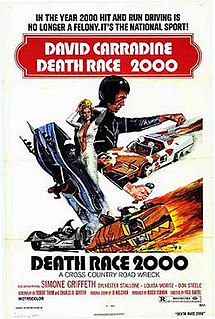
Death Race 2000

Death Race 2000 (1975) is one of my all-time favorite exploitation pictures and it is one of the quintessential Roger Corman productions.  It was made on the cheap, went on to be a financial success, and has since become a cult classic.  It's full of camp, political satire, black humor, high octane automobiles, bloody special effects, action, stunts, nudity, and a cavalcade of recognizable actors.  Loosely based on a short story called 'The Racer' written by Ib Melchior, Death Race 2000 is a graphic, action packed, goofy, live-action cartoon.  It's like an insane combination of Mad Max, The Gumball Rally, and Looney Tunes.
Death Race 2000 takes place in the futuristic year of 2000, after a world financial collapse has turned the USA into the dystopian United Provinces of America, a military/religion/media based dictatorship ran by the smarmy Mr. President.  To calm and entertain the masses, the government started a new national sporting event, the annual Transcontinental Road Race, which is a crazy vehicular cross country race where the drivers are awarded points for hit and run murders.

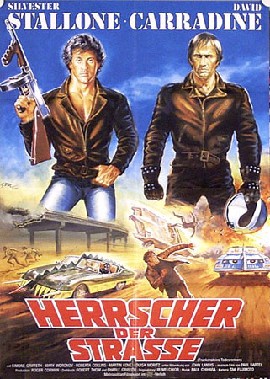
The drivers (along with their navigators) each have their own gimmick.  There's rough and tumble cowgirl Calamity Jane (Mary Woronov), gladiatorial Nero the Hero (Martin Kove), female Nazi Mathilda the Hun (Roberta Collins), Italian mobster-type Machine Gun Joe Viturbo (Sylvester Stallone), and the favorite to win the race, by both the fans and the government, Frankenstein (David Carradine), the only previous two-time winner of the Death Race.
Frankenstein wears an all black outfit, is said to be scarred up and stitched together, and has a mythical-hero status amongst the fans.  He's depicted as a champion and survivor.  This is, of course, all bullshit, as his new navigator Annie Smith (Simone Griffeth) finds out first hand.  Annie though, has her own secrets.  She's part of a resistance force, led by the patriotic Thomasina Paine (yes, great-granddaughter of Thomas Paine) that has taken it upon themselves to disrupt, sabotage, and stop the Transcontinental Road Race in an effort to restore American freedom and democracy to the people (or something like that; their plan and intended results are never made quite clear).
This is a violent film, very bloody at times, but usually done in a comical way.  People are sometimes gouged in the crotch with car mounted knives (it's funny, I swear) or get ran over when they peak out of manhole covers.  Calamity Jane (with her bull designed car) has a showdown with a bullfighter.  There's even a bomb disguised as a baby.  This bloody mayhem is always accompanied by a gleeful sense of playfulness, with the occasional cartoon sound effect or sight gag, such as when one driver speeds their car off a cliff, fooled by a fake tunnel (à la Wily E. Coyote) or later, when the rather useful "hand grenade" is deployed.

The excessive (and cartoony) violence depicted in Death Race 2000 only further underlines its satire and critique on American obsession with mayhem as entertainment.  These satirical elements are personified by the shrill and pandering media, consisting of the fake (but aptly named) Grace Pander (Joyce Jameson, who is "a dear friend of mine"), Howard Cosell-soundalike Harold, and the annoyingly upbeat Junior Bruce (The Real Don Steele).  These three bozos gleefully comment on all the carnage and action during the race (as filtered through the government) and sound like a combination of sportscasters and info-tainment news reporters.  In addition, they broadcast the xenophobic messages of the government (the French are blamed for the attacks against the racers) to help distract the public from domestic issues and further public devotion to their reality television programming.  (Any of this sounding vaguely familiar?)

Since we are talking about a Roger Corman production, it should go without saying that the movie is, on occasion, cheap looking.  There's an obvious matte painting (see above) depicting the future world that is far from convincing and a few of the sets look questionable, while some costumes appear ill-fitting.  The race cars themselves look like they could fall apart at any moment, which was true, as they were mostly made from remodeled Volkswagens overlaid with fiberglass bodies.  Each vehicle had its own design that matched the driver, like Machine Gun Joe with his tommy-gun mounted car, or Calamity Jane with her car that resembles a bull (the horns come in handy).  The cheapness of things only adds to the overall charm, giving the movie that "only-in-the-1970s" feel.  Given the limitations of the production and what, on paper, might seem like a movie that shouldn't work, Death Race 2000 plays amazingly well, with a fast pace, wicked sense of humor, and a seriousness that rarely falters in the face of ridiculousness.  It's a movie that hits on all cylinders, never failing to entertain.

The absurdist elements and humor in the film can be attributed to director Paul Bartel, who also has a small cameo as a doctor.  He has a strange, fey humor and brings a deadpan seriousness to all of the outlandishness of the story.  Bartel also directed the bizarre horror film Private Parts (1972) and the well reviewed Eating Raoul (1982), in which he starred along with Mary Woronov.  He has a very distinct manner (and beard) and can also be seen in Piranha (1978), European Vacation (1985), and Gremlins 2: The New Batch (1990).

Bartel had assistance from his second unit crew (led by writer Charles B. Griffith) in shooting some of the driving and action sequences, and Roger Corman wanted there to be more blood, so he brought in Lewis Teague (future director of Alligator [1980], Cujo [1983], and Cat's Eye [1985]) to shoot some additional gore and bloody insert shots of people getting killed by the cars.  Team effort guys, the Corman way!
Cinematographer Tak Fujimoto would start his career with Terrence Malick's beautiful Badlands (1973) and then follow that with a stint working on mostly B-movies, before hitting a stride with 80s classics Pretty in PinkSomething Wild, and Ferris Bueller's Day Off (all 1986), and mainstream favorites that include The Silence of the Lambs (1991), Philadelphia (1993), and The Sixth Sense (1999).

The screenplay was written by Charles B. Griffith and Robert Thom.  Griffith has a long list of Corman collaborations, including Attack of the Crab Monsters (1957), A Bucket of Blood (1959), Little Shop of Horrors (1960), and The Wild Angels (1966), while Thom's only other significant credited work is a non-Corman production, the psychological incest-revenge film, The Witch Who Came from the Sea (1976).
Sly Stallone plays a good Italian tough guy and eats up his villainous role.  He's really fun and is given some of the best lines ("I got two words to say to that: BULL-SHIT!").  The year after Death Race 2000, Stallone would get (justifiably) great reviews for writing and starring in Rocky, setting the stage for his subsequent success and stardom.

This was David Carradine's first movie role after leaving the TV series Kung-Fu, and he plays it cool as the smooth and smart-assed Frankenstein.  He displays a mysterious smugness that accentuates his sex appeal, maybe best described after he removes his mask and asks, "What did you expect?  Another pretty face?"  Carradine refused to wear leather (he was very much a hippie) and his costume was made out of a stretchy, leather-like fabric.  David Carradine would go on to face-off against a giant flying lizard in Q: The Winged Serpent (1982), Chuck Norris in Lone Wolf McQuade (1983), and with Uma Thurman in Kill Bill Vol. 1 and 2 (2003/04).
Mary Woronov was a product of the Andy Warhol factory and is a cult favorite actress.  She bites into her role as Calamity Jane, giving her a loud, snarky orneriness.  Woronov would go on to star in Eating Raoul, Night of the Comet (1984), TerrorVision (1986), and House of the Devil (2009).

Roberta Collins starred alongside Pam Grier in the women-in-prison films The Big Doll House and Women in Cages (both 1971), as well as Jonathan Demme's take on the genre/directorial debut, Caged Heat (1974).  She was also in Matt Cimber's The Witch Who Came from the Sea and Tobe Hooper's Eaten Alive (1977).

Martin Kove is best known as the evil leader of the Cobra Kai dojo in The Karate Kid movies, but horror fans also know him as one of the dopey cops in Wes Craven's The Last House on the Left (1973).  His navigator, Cleopatra, is played by Leslie McRay, who is recognizable to fans of MST3k as the titular star of The Girl in Gold Boots (1968).

The overly eager announcer Junior Bruce was played by popular and local LA disc jockey The Real Don Steele, who was in a few other Roger Corman productions, including Grand Theft Auto (1977) and Rock and Roll High School (1979).  He is also featured (voice only) as radio disc jockey Rockin' Ricky Rialto in 1984's Gremlins.
Death Race 2000 was remade in 2008 (simply titled Death Race).  The remake has spawned two direct-to-DVD sequels and I've not seen any of these (supposedly horrid) movies, so I can't say anything about them.  I know the remake stars Jason Statham and they ditch the hit-and-run aspect of the story, which sounds shitty and like it defeats the purpose...so ......stick with the original, real deal and accept no substitutes.

Remember:  Women are worth 10+ points in all categories.  Teens rack-up 40 points and toddlers (under 12) are worth a big 70.  And anybody over the age of 75 is worth a whopping 100 points.

*note: Lots of squealing tires in this movie.  None of them on dirt.