Tuesday, March 26, 2013

Re-Animator

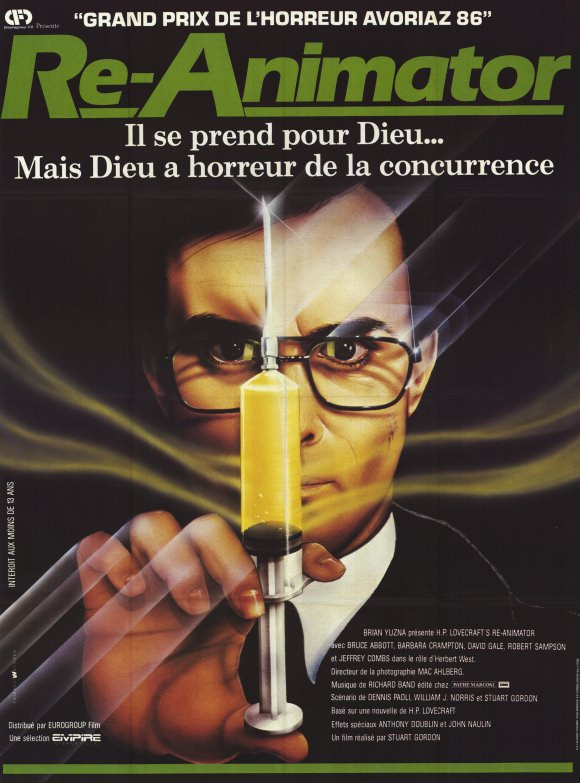
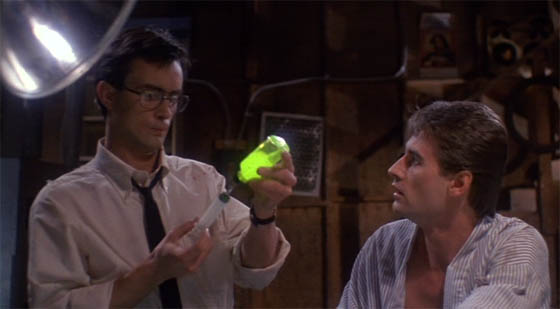
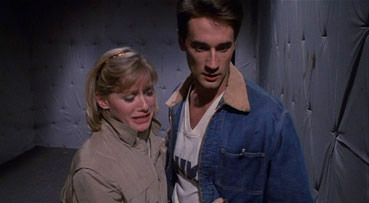
Re-Animator (1985) is an all-time classic horror/comedy/zombie/gore/mad scientist/cult film based on a short story by H.P. Lovecraft concerning a brilliant and obsessive young doctor named Herbert West (Jeffery Combs) who has perfected a serum that brings the dead back to life.  He is a medical student at a school in New England where he finds assistance from his classmate Dan Cain (Bruce Abbott) and opposition is met from Dean Alan Halsey (who is also the father of Dan's girlfriend, Megan [Barbara Crampton]) and the menacing Dr. Hill (David Gale).

I'm fairly sure I don't really need to sell anybody on Re-Animator.  If you're into horror films at all, you've most likely seen it, and if not, you've at least heard of it and quite possibly plan on watching it.  If that's the case, what are you waiting for?  Get to it.

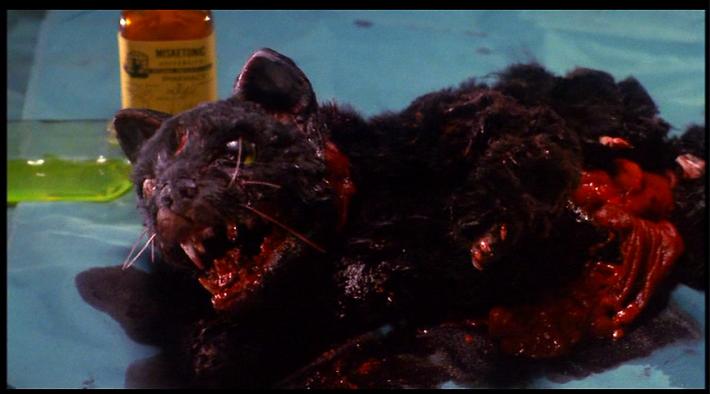
It has this:
this:
this:
this thing here:
this:
some of this:
one of these:
this too:
a little of this:
these guys here:
this:
and this:
That pretty much covers the basics.  Any questions?
Director Stuart Gordon was operating The Organic Theater Company in Chicago, Illinois, when he decided to try his hand at making a movie.  Gordon wanted to do something with the Frankenstein myth, but a friend turned him on to the writings of H.P. Lovecraft, specifically the short story "Herbert West-Reanimator."  Once this concept was decided on, Gordon started to develop the project as a possible half-hour long anthology TV series, but none of the networks were interested in half hour shows (they preferred hour long), nor were they interested in anything horror themed.

Gordon was then introduced to first time producer Brian Yuzna, who had some personal money to spend at the time, as well as the means to raise more funds.  More importantly, Yuzna was a fan of horror films and was an enthusiastic producer.  Dropping the idea to make it an anthology series, they focused on making a feature length movie instead.  The final screenplay is credited to Dennis Paoli, William J. Norris (who was involved more with the TV series proposal), and Stuart Gordon himself, and it makes many deviations from the source story, such as modernizing the setting and adding the characters of Dan, Megan, and Dr. Hill.
Shot in 3 weeks in Los Angeles, Re-Animator would feature a great cast that was more than willing to get gooey and gross with the fantastic special effects work.  The effects were completely practical (all done on set), utilizing gallons of fake blood and animal guts.  The most complicated effects work was done with the severed, re-animated head of Dr. Hill, which was accomplished by using a combination of 7 different techniques to sustain the macabre illusion.  The simplest effect, that of the glowing re-animate serum, would also end up becoming one of the more iconic images from the film.  The sickly, green goo was made from the same solution found most commonly in glow-sticks and its use in Re-Animator was the first time it was seen on screen in a motion picture.

The film is energetically in-your-face and over the top, bringing black, gallows humor in combination with the graphic special effects.  The entire scene with Herbert and Dan chasing Rufus the cat in the basement is both tension filled and a laugh riot.  It's perfectly punctuated by Herbert pulling a "gotcha" on Dan after he hurls the cat at the wall.   The balance of horror and humor in the Re-Animator is comparable to that of other horror/comedies such as House (1986), Evil Dead 2 (1987) and Peter Jackson's Bad Taste (1987) and Dead Alive (1992).
Released in October of 1985, Re-Animator would be met by an enthusiastic public and would even win the critics award at the Cannes film festival that year.  The film would do good financial business and would garner positive reviews from critics Roger Ebert and Pauline Kael.  This feat is even more impressive as the film wasn't submitted to the MPAA and was released 'unrated,' which severely limited how and where the film could be marketed.  The film would later find new life (so to speak) on the home video market where it would cultivate its cult following.
Stuart Gordon would go on to sign a three picture deal with executive producer Charles Band and Empire Pictures, moving to Rome to direct From Beyond (1986, another Lovecraft production), Dolls (1987), and Robot Jox (1989).  He would work again with the same cast and crew on multiple projects.  In recent years, Gordon has returned to directing productions on the stage; his last film was the based-on-a-horrible-true-story Stuck (2007).  One of Stuart Gordon's most interesting film credits (given the rest of his body of work) is a story credit (along with Brian Yuzna) for the family adventure film Honey, I Shrunk the Kids (1989).

Brian Yuzna would produce Stuart Gordon's next two movies and would start directing films himself with the amazing special effects spectacle Society (1989).  He would also direct both Re-Animator sequels, the enthusiastically weird Bride of Re-Animator (1989) and the not so good Beyond Re-Animator (2003).  Brian Yuzna would reteam with Stuart Gordon in 2001, producing his adaptation of Lovecraft's Dagon.
1985 was a busy year for zombie movies, also seeing the release of George Romero's Day of the Dead and Dan O'Bannon's Return of the Living Dead.  Both of those films would see greater financial success, but Re-Animator is a much more entertaining and enjoyable film when compared to the rather bleak (but admittedly still entertaining) Day of the Dead or the rather stupid ROTLD (for my money, I've always preferred Part III (1993) of that series, which happens to be directed by Brian Yuzna).
"Mr. West, I suggest you get yourself a pen!"
Jeffrey Combs gained genre icon status with his portrayal of Herbert West, giving him this detached sense of superiority and brashness.  Combs has a great, intelligent snideness about him, playing complicated weirdos with the seemingly greatest of ease.   He would reprise his role as Herbert West in the two Re-Animator sequels, as well as work with Stuart Gordon another 7 times.  He was also in Peter Jackson's ghost-fest The Frighteners (1996) as the beyond troubled Milton Dammers.

David Gale plays a great villain and has a classic screen presence about him, a more gothic look, like he belongs in a Frankenstein film or something, which might actually be why his casting is so apt.  A subplot was cut out of the finished film depicting Dr. Hill as having hypnotic powers, unnecessarily explaining his control over the zombies later in the film.  David Gale would reprise his role as Dr. Hill in the sequel, Bride of Re-Animator, apparently in spite of his character's condition at the end of the first film.  His promising film career would be cut short by his untimely death in 1991.
Barbara Crampton was very brave to be in this film, considering what her character has to go through later in the movie.  She's really great in the role as Megan, giving her sincerity and confidence, and not just playing her as a terrified, helpless girl (although she does have a great scream).  Her scenes with Bruce Abbott really ground the film and give it a sense of normalcy amongst all the chaos and these weird, eccentric characters.  Kudos to Abbott for playing an excellent everyman and really holding the movie together.
The art direction was done by the great Robert A. Burns (Texas Chainsaw Massacre, Mausoleum) and I'd like to think it was his choice to hang up that big Talking Heads poster on the wall behind Dan's bed during all the love making scenes.
The writer of the film Dennis Paoli would also write Gordon's From Beyond, The Pit and the Pendulum (1991), Castle Freak (1995), and both of his Masters of Horror entries.  He would also pen Brian Yuzna's dental horror/Corbin Bernsen showcase The Dentist (1996) and its 1998 sequel.  At his day job, Paoli is a professor of gothic literature at Hunter College in New York City.

The iconic theme song by Richard Band (Charlie Band's brother) borrows motifs from Bernard Herrmann's score for Psycho (1960), which has caused him to be accused of being a hack and/or a plagiarist (by some).  I think by borrowing from a film score as famous as Psycho it gives the music a playfulness that alerts the audience that, yes, you are watching a horror film, and yes it's okay to laugh and have fun.  The opening animated credits add to this feeling, as if you are getting ready to watch some sort of demented cartoon.
The cinematographer Mac Ahlberg was an Empire Pictures vet, also shooting the low budgeted (but entertaining) Ghoulies, Trancers (both 1985), and Eliminators (1986).  He helped educate Gordon on the craft of filmmaking during the production of Re-Animator, sometimes through gentle arguments and heated disagreements.  They apparently forged a strong working relationship, as they'd work together on another five films.

Ahlberg is quoted as saying that David Bowie has told him that Re-Animator is his favorite movie.

If that's not an endorsement, I don't know what is.

Thursday, March 21, 2013

Death Race 2000

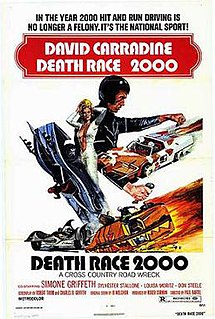
Death Race 2000 (1975) is one of my all-time favorite exploitation pictures and it is one of the quintessential Roger Corman productions.  It was made on the cheap, went on to be a financial success, and has since become a cult classic.  It's full of camp, political satire, black humor, high octane automobiles, bloody special effects, action, stunts, nudity, and a cavalcade of recognizable actors.  Loosely based on a short story called 'The Racer' written by Ib Melchior, Death Race 2000 is a graphic, action packed, goofy, live-action cartoon.  It's like an insane combination of Mad Max, The Gumball Rally, and Looney Tunes.
Death Race 2000 takes place in the futuristic year of 2000, after a world financial collapse has turned the USA into the dystopian United Provinces of America, a military/religion/media based dictatorship ran by the smarmy Mr. President.  To calm and entertain the masses, the government started a new national sporting event, the annual Transcontinental Road Race, which is a crazy vehicular cross country race where the drivers are awarded points for hit and run murders.

The drivers (along with their navigators) each have their own gimmick.  There's rough and tumble cowgirl Calamity Jane (Mary Woronov), gladiatorial Nero the Hero (Martin Kove), female Nazi Mathilda the Hun (Roberta Collins), Italian mobster-type Machine Gun Joe Viturbo (Sylvester Stallone), and the favorite to win the race, by both the fans and the government, Frankenstein (David Carradine), the only previous two-time winner of the Death Race.
Frankenstein wears an all black outfit, is said to be scarred up and stitched together, and has a mythical-hero status amongst the fans.  He's depicted as a champion and survivor.  This is, of course, all bullshit, as his new navigator Annie Smith (Simone Griffeth) finds out first hand.  Annie though, has her own secrets.  She's part of a resistance force, led by the patriotic Thomasina Paine (yes, great-granddaughter of Thomas Paine) that has taken it upon themselves to disrupt, sabotage, and stop the Transcontinental Road Race in an effort to restore American freedom and democracy to the people (or something like that; their plan and intended results are never made quite clear).
This is a violent film, very bloody at times, but usually done in a comical way.  People are sometimes gouged in the crotch with car mounted knives (it's funny, I swear) or get ran over when they peak out of manhole covers.  Calamity Jane (with her bull designed car) has a showdown with a bullfighter.  There's even a bomb disguised as a baby.  This bloody mayhem is always accompanied by a gleeful sense of playfulness, with the occasional cartoon sound effect or sight gag, such as when one driver speeds their car off a cliff, fooled by a fake tunnel (à la Wily E. Coyote) or later, when the rather useful "hand grenade" is deployed.

The excessive (and cartoony) violence depicted in Death Race 2000 only further underlines its satire and critique on American obsession with mayhem as entertainment.  These satirical elements are personified by the shrill and pandering media, consisting of the fake (but aptly named) Grace Pander (Joyce Jameson, who is "a dear friend of mine"), Howard Cosell-soundalike Harold, and the annoyingly upbeat Junior Bruce (The Real Don Steele).  These three bozos gleefully comment on all the carnage and action during the race (as filtered through the government) and sound like a combination of sportscasters and info-tainment news reporters.  In addition, they broadcast the xenophobic messages of the government (the French are blamed for the attacks against the racers) to help distract the public from domestic issues and further public devotion to their reality television programming.  (Any of this sounding vaguely familiar?)

Since we are talking about a Roger Corman production, it should go without saying that the movie is, on occasion, cheap looking.  There's an obvious matte painting (see above) depicting the future world that is far from convincing and a few of the sets look questionable, while some costumes appear ill-fitting.  The race cars themselves look like they could fall apart at any moment, which was true, as they were mostly made from remodeled Volkswagens overlaid with fiberglass bodies.  Each vehicle had its own design that matched the driver, like Machine Gun Joe with his tommy-gun mounted car, or Calamity Jane with her car that resembles a bull (the horns come in handy).  The cheapness of things only adds to the overall charm, giving the movie that "only-in-the-1970s" feel.  Given the limitations of the production and what, on paper, might seem like a movie that shouldn't work, Death Race 2000 plays amazingly well, with a fast pace, wicked sense of humor, and a seriousness that rarely falters in the face of ridiculousness.  It's a movie that hits on all cylinders, never failing to entertain.

The absurdist elements and humor in the film can be attributed to director Paul Bartel, who also has a small cameo as a doctor.  He has a strange, fey humor and brings a deadpan seriousness to all of the outlandishness of the story.  Bartel also directed the bizarre horror film Private Parts (1972) and the well reviewed Eating Raoul (1982), in which he starred along with Mary Woronov.  He has a very distinct manner (and beard) and can also be seen in Piranha (1978), European Vacation (1985), and Gremlins 2: The New Batch (1990).

Bartel had assistance from his second unit crew (led by writer Charles B. Griffith) in shooting some of the driving and action sequences, and Roger Corman wanted there to be more blood, so he brought in Lewis Teague (future director of Alligator [1980], Cujo [1983], and Cat's Eye [1985]) to shoot some additional gore and bloody insert shots of people getting killed by the cars.  Team effort guys, the Corman way!
Cinematographer Tak Fujimoto would start his career with Terrence Malick's beautiful Badlands (1973) and then follow that with a stint working on mostly B-movies, before hitting a stride with 80s classics Pretty in Pink, Something Wild, and Ferris Bueller's Day Off (all 1986), and mainstream favorites that include The Silence of the Lambs (1991), Philadelphia (1993), and The Sixth Sense (1999).

The screenplay was written by Charles B. Griffith and Robert Thom.  Griffith has a long list of Corman collaborations, including Attack of the Crab Monsters (1957), A Bucket of Blood (1959), Little Shop of Horrors (1960), and The Wild Angels (1966), while Thom's only other significant credited work is a non-Corman production, the psychological incest-revenge film, The Witch Who Came from the Sea (1976).
Sly Stallone plays a good Italian tough guy and eats up his villainous role.  He's really fun and is given some of the best lines ("I got two words to say to that: BULL-SHIT!").  The year after Death Race 2000, Stallone would get (justifiably) great reviews for writing and starring in Rocky, setting the stage for his subsequent success and stardom.

This was David Carradine's first movie role after leaving the TV series Kung-Fu, and he plays it cool as the smooth and smart-assed Frankenstein.  He displays a mysterious smugness that accentuates his sex appeal, maybe best described after he removes his mask and asks, "What did you expect?  Another pretty face?"  Carradine refused to wear leather (he was very much a hippie) and his costume was made out of a stretchy, leather-like fabric.  David Carradine would go on to face-off against a giant flying lizard in Q: The Winged Serpent (1982), Chuck Norris in Lone Wolf McQuade (1983), and with Uma Thurman in Kill Bill Vol. 1 and 2 (2003/04).
Mary Woronov was a product of the Andy Warhol factory and is a cult favorite actress.  She bites into her role as Calamity Jane, giving her a loud, snarky orneriness.  Woronov would go on to star in Eating Raoul, Night of the Comet (1984), TerrorVision (1986), and House of the Devil (2009).

Roberta Collins starred alongside Pam Grier in the women-in-prison films The Big Doll House and Women in Cages (both 1971), as well as Jonathan Demme's take on the genre/directorial debut, Caged Heat (1974).  She was also in Matt Cimber's The Witch Who Came from the Sea and Tobe Hooper's Eaten Alive (1977).

Martin Kove is best known as the evil leader of the Cobra Kai dojo in The Karate Kid movies, but horror fans also know him as one of the dopey cops in Wes Craven's The Last House on the Left (1973).  His navigator, Cleopatra, is played by Leslie McRay, who is recognizable to fans of MST3k as the titular star of The Girl in Gold Boots (1968).

The overly eager announcer Junior Bruce was played by popular and local LA disc jockey The Real Don Steele, who was in a few other Roger Corman productions, including Grand Theft Auto (1977) and Rock and Roll High School (1979).  He is also featured (voice only) as radio disc jockey Rockin' Ricky Rialto in 1984's Gremlins.
Death Race 2000 was remade in 2008 (simply titled Death Race).  The remake has spawned two direct-to-DVD sequels and I've not seen any of these (supposedly horrid) movies, so I can't say anything about them.  I know the remake stars Jason Statham and they ditch the hit-and-run aspect of the story, which sounds shitty and like it defeats the purpose...so ......stick with the original, real deal and accept no substitutes.

Remember:  Women are worth 10+ points in all categories.  Teens rack-up 40 points and toddlers (under 12) are worth a big 70.  And anybody over the age of 75 is worth a whopping 100 points.

*note: Lots of squealing tires in this movie.  None of them on dirt.

Sunday, March 17, 2013

Pieces

"You don't have to go to Texas for a chainsaw massacre!"

Pieces (1982) is an incredibly fun and extremely trashy film, soaked in gore and teaming with sleaze.  It's the very definition of a crowd pleaser and I absolutely love it.  Sure, it doesn't make sense half the time, it has awkward overdubbing and weird dialogue, but when it rips and roars, it never fails to entertain.

Hailing from Spain, Pieces was made to cash in on the American slasher craze of the 1980s, but owes a lot of its style and mystery elements to the Italian giallo films of the 60s and 70s, which in turn themselves were part of the inspiration for their American slasher cousins.  Pieces, I guess then, would be the strange ouroboros of slasher films.  (I considered going into deeper detail and explanation on slasher and giallo films for those that aren't familiar, but I'm feeling lazy, so just go HERE and HERE for more information.  We'll meet back up here later).
Pieces opens in Boston, 1942, as a young boy named Timmy is alone in his room playing with an erotic puzzle.  When his mother finds him, she go ballistic, smacking him, smashing his mirror, and yelling for him to "go get a bag for all this trash."  Instead, Timmy comes back with an axe and proceeds to smash her skull in.  He then grabs a saw and cuts her head off.  Timmy is seriously disturbed, but he knows to play the "some big guy did it" game when the police and a concerned family friend show up.

Flash-forward 40 years later and a deranged psycho is slicing up co-eds with a chainsaw on a college campus.  The lead detectives on the case, Lt. Bracken (Christopher George) and Sgt. Holden (Frank Braña), have their work cut out for them, as almost everybody seems to be a suspect, and bodies keep piling up all over campus (minus a few parts).

They decide to bring in a young policewoman (and former tennis pro), Mary Riggs (Lynda Day George), to go undercover on campus, posing as (naturally) the new tennis instructor.  There are plenty of suspects and red herrings alike, including brutish groundsman Willard (Paul L. Smith), fey and wormy Professor Brown (Jack Taylor), the fastidious Dean (Edmund Purdom), and Kendall (Ian Sera), a student at the school who is also quite the ladies man.
Ladies and gentlemen...your suspects!
Most of the time things happen and it's not made very clear why.  After the 1942 opening, we get a comical scene of a girl named Ginnie riding her skateboard down the city street, oblivious to the pair of movers carrying a giant mirror right in front of her on the sidewalk.  She smashes into the mirror, but in the very next scene she is totally okay.  She's hanging out, laying in the grass and studying, before the killer shows up and cuts her head off with a chainsaw (complete with a perfect gush of blood from the neck). Apparently, the mirror smashing is the event that incites the killer's rampage and he kills Ginnie some days after the incident, but the way the scenes are cut together it is almost impossible to interpret that any time has elapsed between them.  Pieces main plan of attack on viewers seems to be a dual effort to both confuse and shock.

The most (in)famous WTF-scene in Pieces is later in the movie, when tennis prolicewoman Mary is out walking around by herself at night and is suddenly attacked by a Bruce Lee impersonator (actual Bruce Lee impersonator, Bruce Le) doing all these kung fu moves on her.  It's of course a misunderstanding, as Kendall shows up on his motorbike, explaining "it's my kung-fu professor.  What's the story, Chow?"  Chow's response is both amazing and confusing:  "I am out jogging and next thing I know, I am on ground.  ...Something I eat, bad chop suey.  So long!"
That is but one example of the weird dialogue exchanged in this film.  One sultry student is heard bragging to her classmates, "the most beautiful thing in the world is smoking pot and fucking on a waterbed...at the same time."  Lt. Bracken has a detailed theory that "the killer is either someone on or near the campus," while Sgt. Holden makes this attempt at a hard boiled analogy: "We're just out buying clothes without labels and trying them on for size."

The most memorable and best line delivered in the movie is actually a single word screamed three times by Mary in a moment of ultimate frustration, after discovering yet another of the killer's victims.  I'll just let Mrs. Lynda Day George speak her mind:

The original Spanish language title of the film is Mil Gritos Tiene la Noche (translates as "One Thousand Cries has the Night"), which, while being a cool title, doesn't really describe the film very well.  As is, Pieces definitely lives up to its name and reputation and it's easy to allow the film's technical issues to be forgiven, as the pace and sheer intensity of the film never let up and doesn't give you time to consider some of the absurdities (how did he get that chainsaw on the elevator unnoticed?).

The stalking and chase scenes are fairly well done, with excellent cat-and-mouse pacing.  The stalking that leads to the murder on the waterbed is one of the best in the movie, taking some obvious visual cues from the Italian giallos, such as the high contrast and colored lighting and by using slo-mo.  Also, the violence is more operatic in this scene than, say, in the elevator or bathroom stall murders, which, while shockingly violent and gory, don't approach any sort of aesthetic artfulness in their execution.

The killer's outfit is also very giallo inspired, with black gloves, long trench coat, and a brimmed hat that obscures the face.  It's quite the stylish look, one that invokes mystery and menace, and can be directly traced to back to the killers in Mario Bava's Blood and Black Lace (1964) and Dario Argento's The Bird with the Crystal Plumage (1970) and Deep Red (1975).
The special effects are rather accomplished, especially for a low budget film.  All the stops were pulled and seemingly no ounce of blood was spared.  In the previously mentioned bathroom stall murder, a pig carcass was used for a closeup shot of the saw tearing through flesh.  It's remarkably effective.  The violence in this film has been accused of being misogynist, but there isn't any underlying hatefulness going on in any of the murder scenes, just over the top excess.  The lack of hateful feeling is what keeps Pieces an enjoyable viewing experience.

The moody synth score adds a lot to the enjoyment of Pieces as well.  It was included for the US and Italian release of the film and was performed by Carlo Maria Cordio, who also scored Aenigma (1987), Touch of Death (1988), Sonny Boy (1989), and cult-classic Troll 2 (1990).  The original score (which is available on the Grindhouse Releasing DVD) was taken from the Italian CAM (Creazoni Artistiche Musicali) music library (credited to Librado Pastor).  Comparatively, it is a fairly boring score, with a repetitious piano melody.  It's a good thing they switched it up for the international release.  (There's also this disco gem used during a very '80s aerobics scene).
Pretty much everyone who worked behind the camera on Pieces would work with director Juan Piquer Simón on many of his other (lesser) films, which include The Fabulous Journey to the Center of the Earth (1977), Mystery on Monster Island (1980), Slugs: The Movie (1988), The Rift (1990), and Cthulhu Mansion (1992).  His 1983 movie, The Pod People, would be featured in a classic Season 3 episode of Mystery Science Theater 3000.

One of the writers of the film, Joe D'Amato (going under the alias John W. Shadow), was a prolific Italian filmmaker who directed 200 films, many of those explotiation-stlyle pornography (soft and hardcore).  His non-porno credits include Beyond the Darkness (1979) and Anthropophagous (1980).
Christopher George is a B-movie icon, with his deadpan manner and macho attitude.  He would star in William Girdler's Grizzly (1976) and Day of the Animals (1977), Lucio Fulci's City of the Living Dead (1980), as well as The Exterminator (1980), Graduation Day (1981), Enter the Ninja (1981), and Mortuary (1983), which would be his last film.  He would die of a heart attack (complicated by his smoking habit) shortly after completing that film.  Interesting fact: his niece is Wheel of Fortune hostess Vanna White.

Lynda Day George was married to Christopher George for 14 years.  She would star alongside him in Day of the Animals and Mortuary (amongst others) and would also star in the possession film Beyond Evil (1980) with John Saxon.  She also had an extensive career in television, most notably as Lisa Casey on Mission: Impossible.  In Pieces, her character of Mary Riggs is supposed to be a modern multi-talented woman, but Lynda Day George isn't very convincing as a policewoman, and she's even less convincing as a tennis player (there's one very stiff and awkward scene where she plays a round of tennis, the actress playing her opponent not knowing how to play either).
Edmund Purdom was a classically trained actor who never broke through in Hollywood, so he moved to Italy in the 1960s and started a long career in television, voice dubbing work, and in B-movies.  He would star in such films as Frankenstein's Castle of Freaks (1974), Ator, the Fighting Eagle (1982, directed by Pieces writer, Joe D'Amato), 2019: After the Fall of New York (1983), and the Santa-slasher, Don't Open Till Christmas (1984), which would also be his sole directorial credit.

The big and burly Paul L. Smith is best known as portraying Bluto in Robert Altman's Popeye (1980), but he's also been in genre fare like Dune (1984), Crimewave and Red Sonja (both 1985), Haunted Honeymoon (1986), Gor (1987), and Sonny Boy (1989).  There's an extensive and entertaining interview with him on the previosuly mentioned DVD release, where he talks about everything from Otto Preminger and the Six-Days War in Israel to David Lynch and Dom DeLuise.  In Pieces, it seems he is constantly making this face:
Like a lot of directors, Juan Piquer Simón had his repertoire of actors (i.e. buddies that would be in his movies) that he would regularly use.  Frank Braña was his DeNiro; they collaborated on a total of 9 films.  Jack Taylor worked with Simón a couple times and has an dense filmography that extends from Jess Franco (Eugenie [1970], Female Vampire [1974]) to Roman Polanski (The Ninth Gate [1999]).  Ian Sera doesn't have much of a filmography outside of his films with Simón and if he's known at all today, he's known as either the-guy-who-gets-the-raw-deal-at-the-end-of-Pieces or the "It stinks!" guy from The Pod People.

Speaking of the ending to Pieces, it is something that can only be described as bat-shit crazy.  It's a jawdropper that comes completely out of left-field and has to be seen to be believed.  It will grab you.

Final Thought:  "Pieces.  It's exactly what you think it is!"  So see it already.